
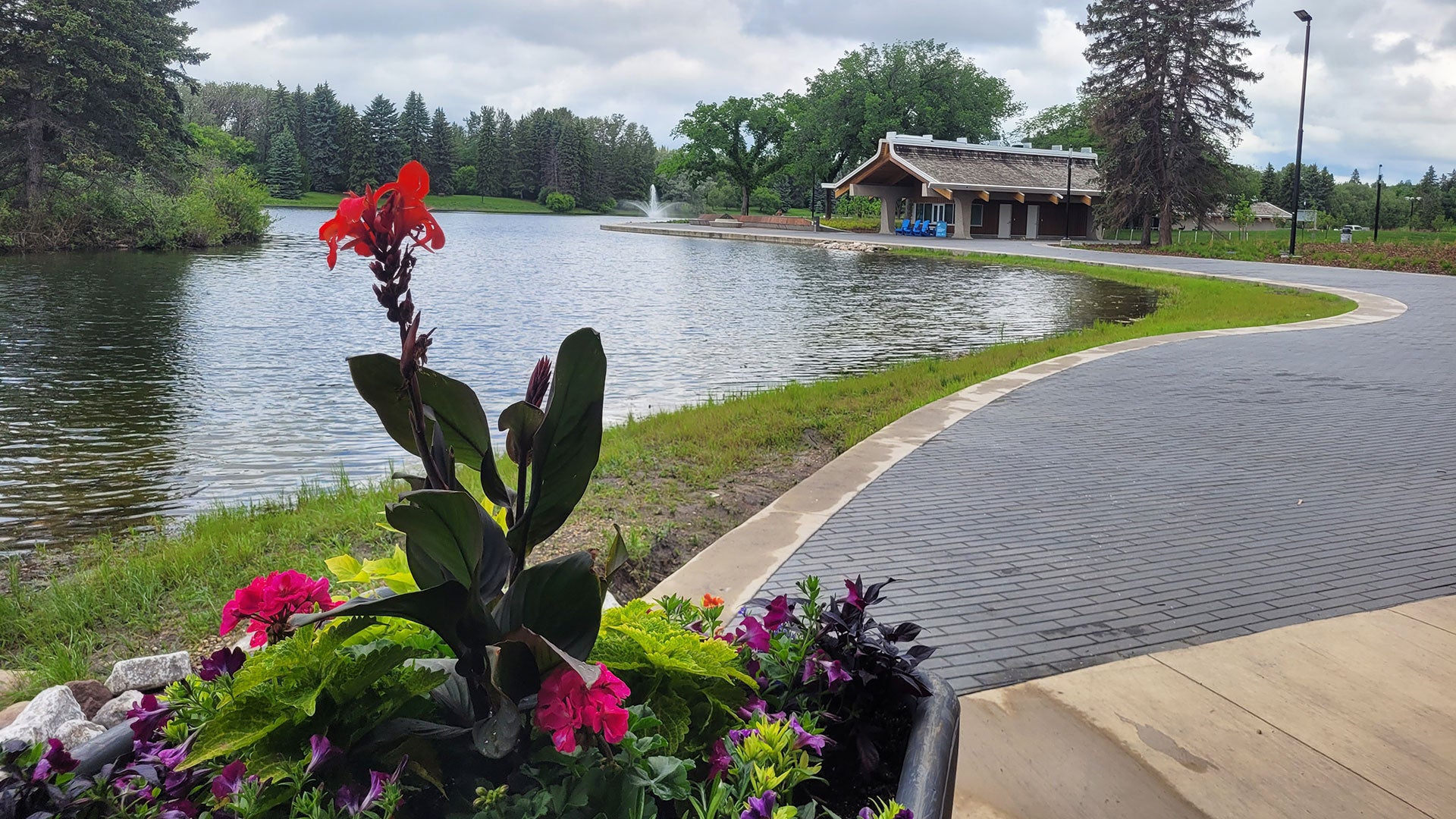
NAIT grads discuss rebuilding of cherished Edmonton park for another half-century of enjoyment
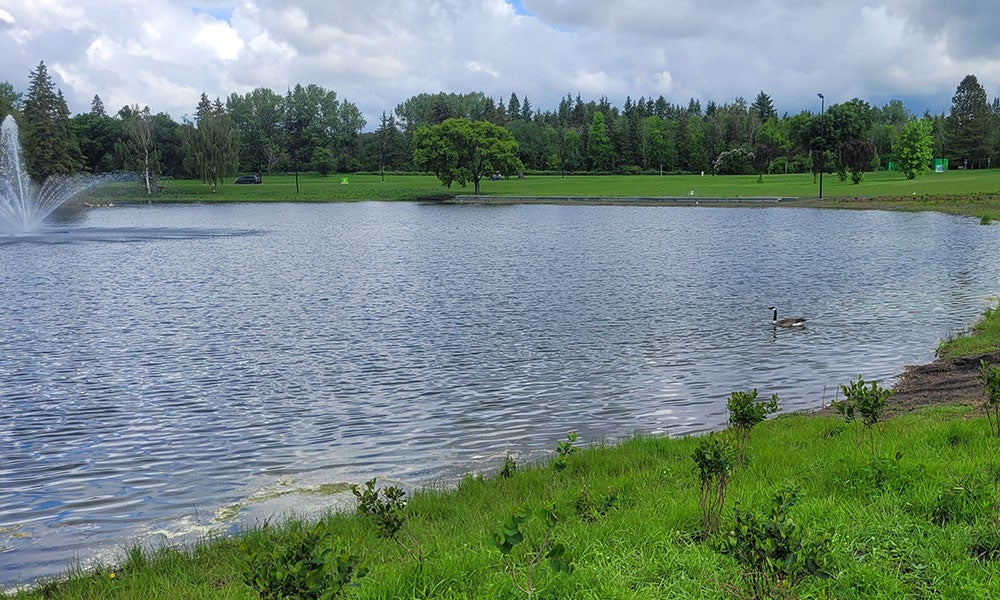
Not long before a recent overcast summer morning, the shimmering five-hectare lake we’re admiring wasn’t actually here. It was drained, the bottom regraded and scrubbed of untold kilograms of goose poop.
And the adjacent deck that we’re standing on – a vast platform connecting to a main pavilion that now hosts a restaurant – never existed at all. For how well it complements the lake, however, it’s like it has always been here as the heart of the newly rehabilitated William Hawrelak Park, originally opened in 1967.
“Some of the feedback we've heard is that the park doesn't look much different,” says Phil Nastiuk (Architectural Technology ’02), a City of Edmonton project manager who helped oversee the $134.6-million overhaul.
The comment is staggering, given that most of this 68-hectare space was disturbed during the three-year closure to rehabilitate infrastructure dating back almost half a century. “But it’s actually a compliment,” Nastiuk adds.
What went into creating the illusion? A lot of planning, digging, building, moving, coordinating and communicating.
Soon after the official reopening on May 30, 2026, we joined Nastiuk, program manager Alisha Meunier (Bachelor of Technology ’13, Architectural Technology ’08), and facility infrastructure delivery director Jesse Banford (Construction Engineering Technology ’01) for a tour that revealed how the park was prepared for another half-century of wowing visitors while making them feel that one of Edmonton’s most cherished places has remained one of its most familiar.
Stop 1: Lingering at the lake
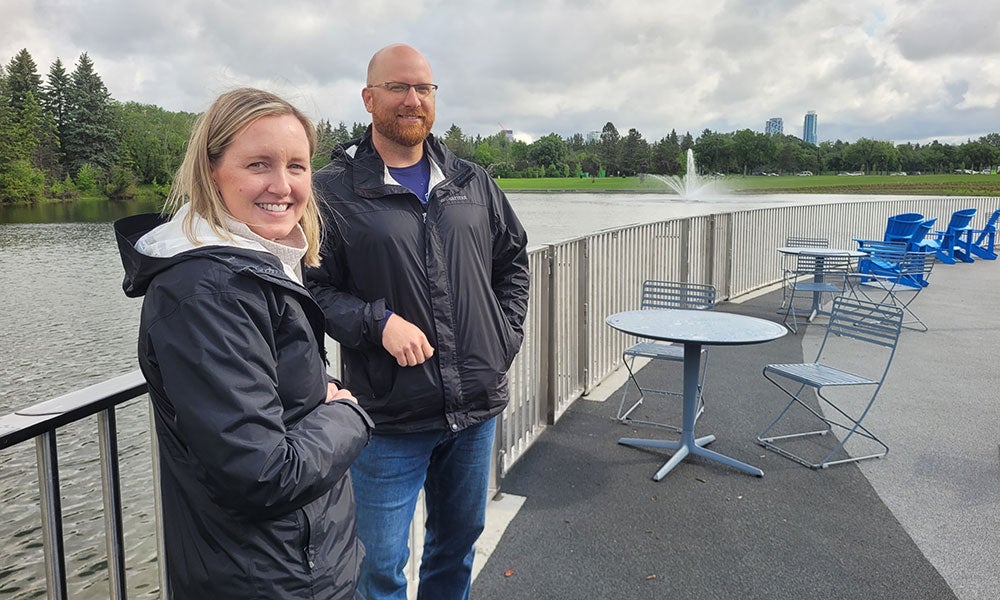
The work on and around the lake represents the extreme nature of the park’s rehabilitation. While the project could have proceeded as piecemeal maintenance, Nastiuk (above right) notes that the time had come to be more forward-looking.
“Accessibility, security and safety were key components of what we were trying to do,” he says. That couldn’t be achieved through Band-Aid repairs.
For example, the surface of the new deck is rubberized. In winter, skaters can lace up and walk across to the frozen lake through gates built into the railing. “So we went from a three-season asset to a four-season asset,” says Banford.
As well, there are no steps that lead to that new deck, allowing visitors to easily reach the water’s edge or grab coffee from the café, Lift Me Up on the Lake. It’s a seamless transition from the surrounding network of newly paved paths. “Where we’re standing now was essentially grass,” says Meunier (above left). “Adding this piece was key.”
Stop 2: A stroll by boathouse
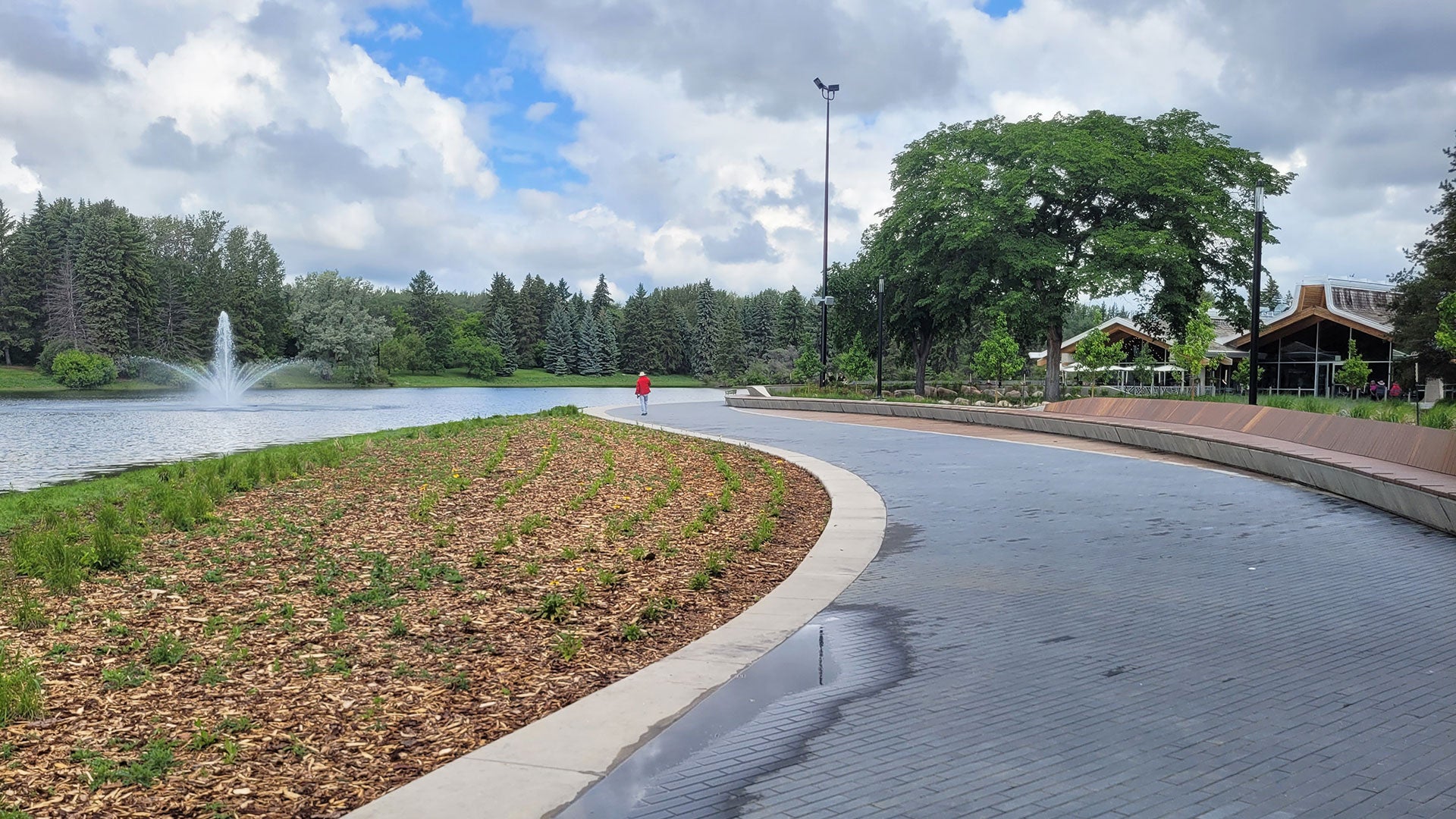
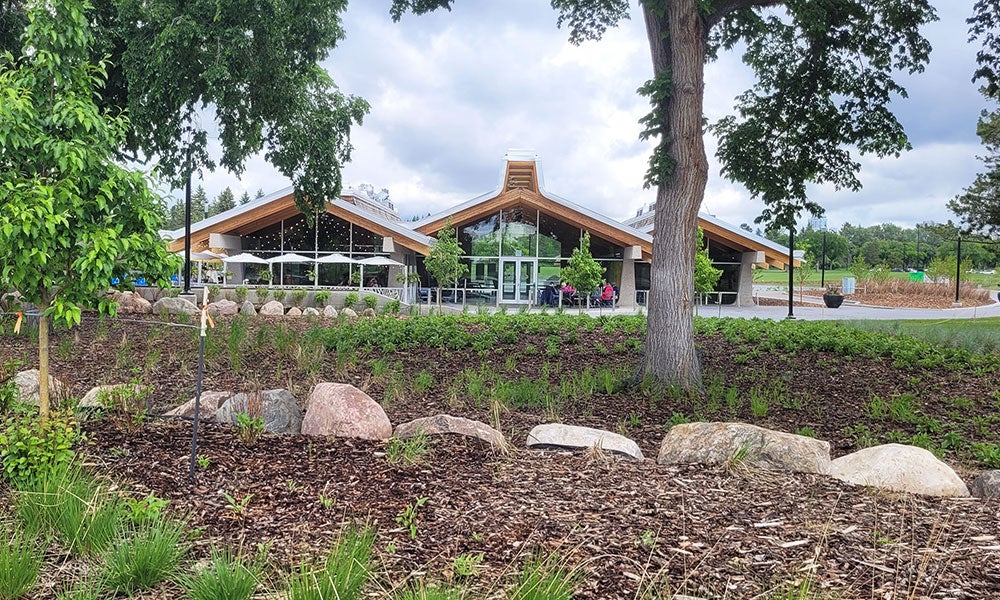
Southeast of the deck, a brick promenade hugs the lakeshore and passes the boathouse – a vintage, modernist structure that matches two picnic shelters and the main pavilion, and no doubt helps anchor the park in the memories of visitors.
Designed by local architects and built between 1968 and 1973, the buildings are unique for their thick concrete columns and broad cedar roofs. As part of the rehabilitation, they were officially designated as Municipal Historic Resources in 2023 under the Alberta Historical Resources Act. The collaborator, City of Edmonton Historic Resources, was just one of more than 100 project stakeholders.
“There's a lot of interaction with a greater team at the City and other people,” says Meunier, who played a lead role in managing those relationships.
In addition, work on the nearby amphitheatre meant considering the needs of arts groups such as the Free Will Players, rehearsing Shakespeare’s Much Ado About Nothing during our tour. Working so close to the river even required consultation with federal conservation partners.
Stop 3: The vanished hill (and other invisible features)
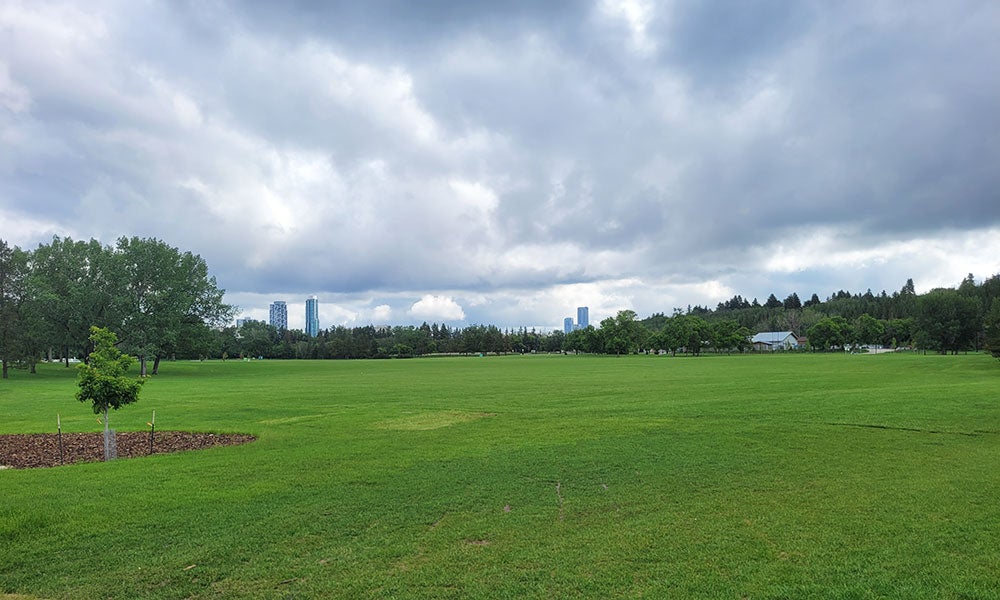
Northeast of the amphitheatre is nothing – but a conspicuous nothing. During rehabilitation, “there was actually a dirt pile that … could have been a toboggan hill,” says Nastiuk.
Now blanketed in a portion of the 150,000 square metres of sod (more than 21 soccer pitches) stretched over the park, the flat green space was the repository for earth removed to reach dozens of kilometres of buried utilities, such as gas, electricity and sewer. The material was replaced following amendments to help plant growth.
“It sounds funny, but even the soil was old,” says Nastiuk.
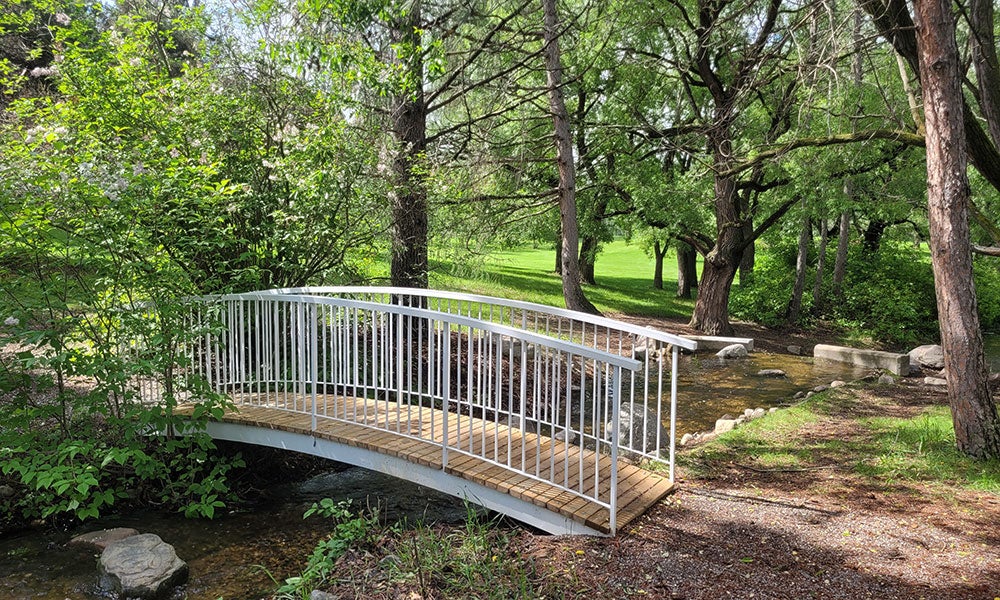
The empty site hosts improvements of its own, too. Previously, the spring melt pooled here in a pond so vast it had its own nickname of “Jackfish Lake.” New underground infrastructure now eases that water away into the North Saskatchewan River as part of stormwater management.
The underground solution reminds Meunier of another hidden innovation. Located strategically throughout the park, “festival vaults” are where underground utilities collect and breach as convenient connection points.
“Before, when you’d come to Heritage Days, there would be hoses and electrical cords everywhere,” she says. “We're trying to minimize that.”
Stop 5: Giant chickadees and fake trees
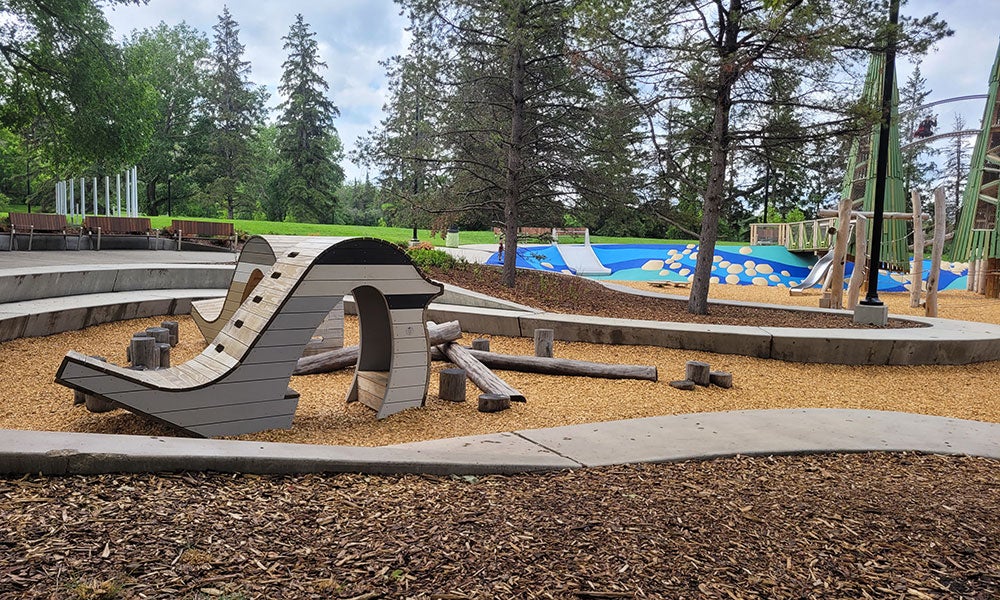
Move over monkey bars – this place is for the birds.
The new playground, east of the amphitheatre, is designed to “tie into all the existing landscaping,” says Nastiuk. It curves around mature trees, creating nest-like areas full of wooden play structures, including two oversize chickadees, to be climbed on and inside.
Located nearby is a washroom, completely refurbished and reconfigured as one of the park's two gender-neutral facilities.
Stop 6: The big picture
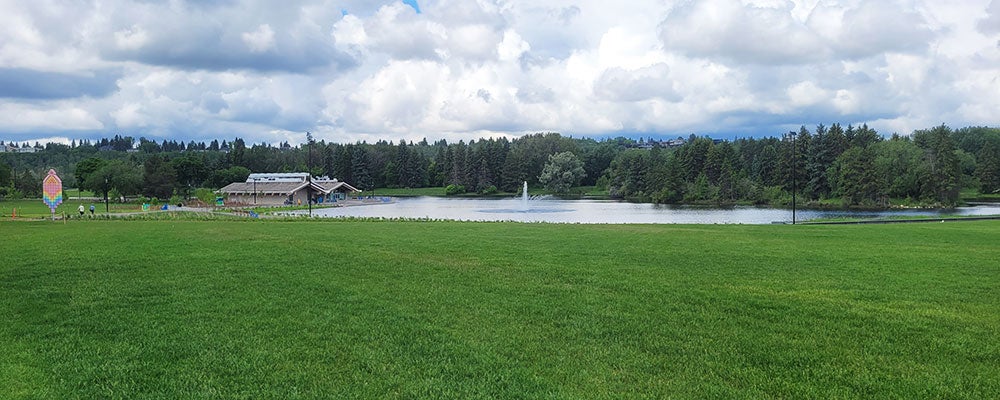
Across from the maintenance yard in the northeast corner of the park – the site of the project’s only new building, designed primarily for storage – we pause along the path. Cyclists and runners pass. We watch people make the short hike from the parking lot, complete with 14 accessible stalls, to the main pavilion. The cloudy sky doesn’t stop them.
“I judge how well a project [went] by the size of a smile of those that are using it,” says Banford (below, left).
That enjoyment isn’t reserved for visitors. The grads share it, too.
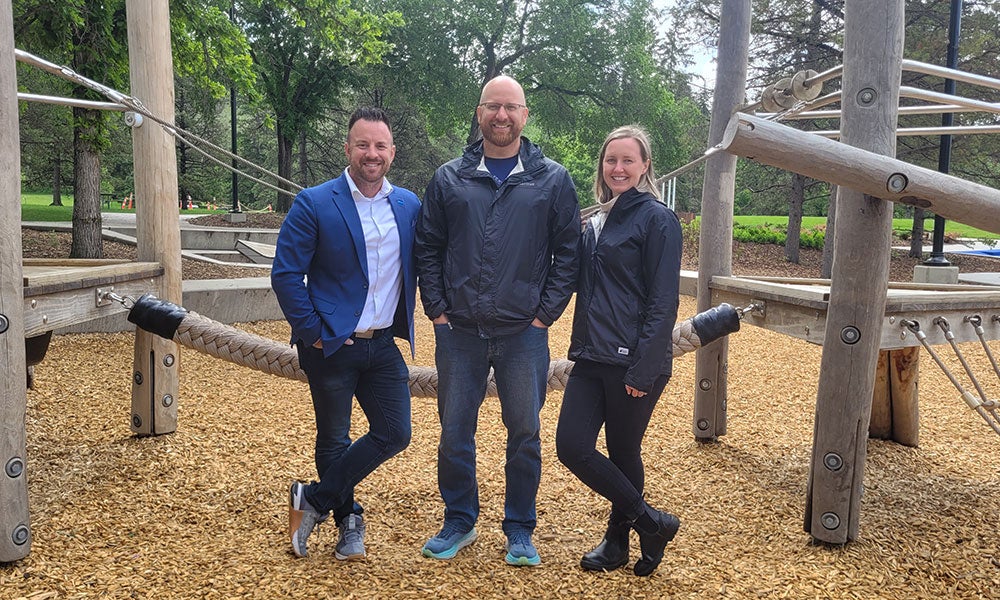
“I got to work in a park for three years,” says Nastiuk. “It was nice to come in the morning and … it didn't feel like a construction zone: the birds are chirping, the sun's coming up, there's still dew on the grass.”
And, when the work was done and the park reopened, “the stuff that you talked about at the dinner table, [your family] gets to see how it turned out,” says Meunier. “You get to bring them here and show them.”
It’s OK if they weren’t completely taken aback by the changes. Comfort can be found in the functional and familiar. Banford might add that so can beauty.
“It’s home,” he says of Hawrelak Park. “It’s our own back yard.”
If you enjoyed that article, try these:
Northern Alberta Institute of Technology
Mailing Address:
11762 - 106 Street
Edmonton, AB, Canada, T5G 2R1
At NAIT, we honour and acknowledge that the land on which we learn, work and live is Treaty Six territory. We seek to learn from history and the lessons that have come before us, and to draw on the wisdom of the First Peoples in Canada. Only through learning can we move forward in truth and reconciliation, and to a better future together. Read more
About techlifetoday
Techlifetoday is the source for NAIT alumni and students to discover news about the polytechnic, and insights, advice and inspiration from the NAIT community to help them build successful careers and lead fulfilling lives.
