
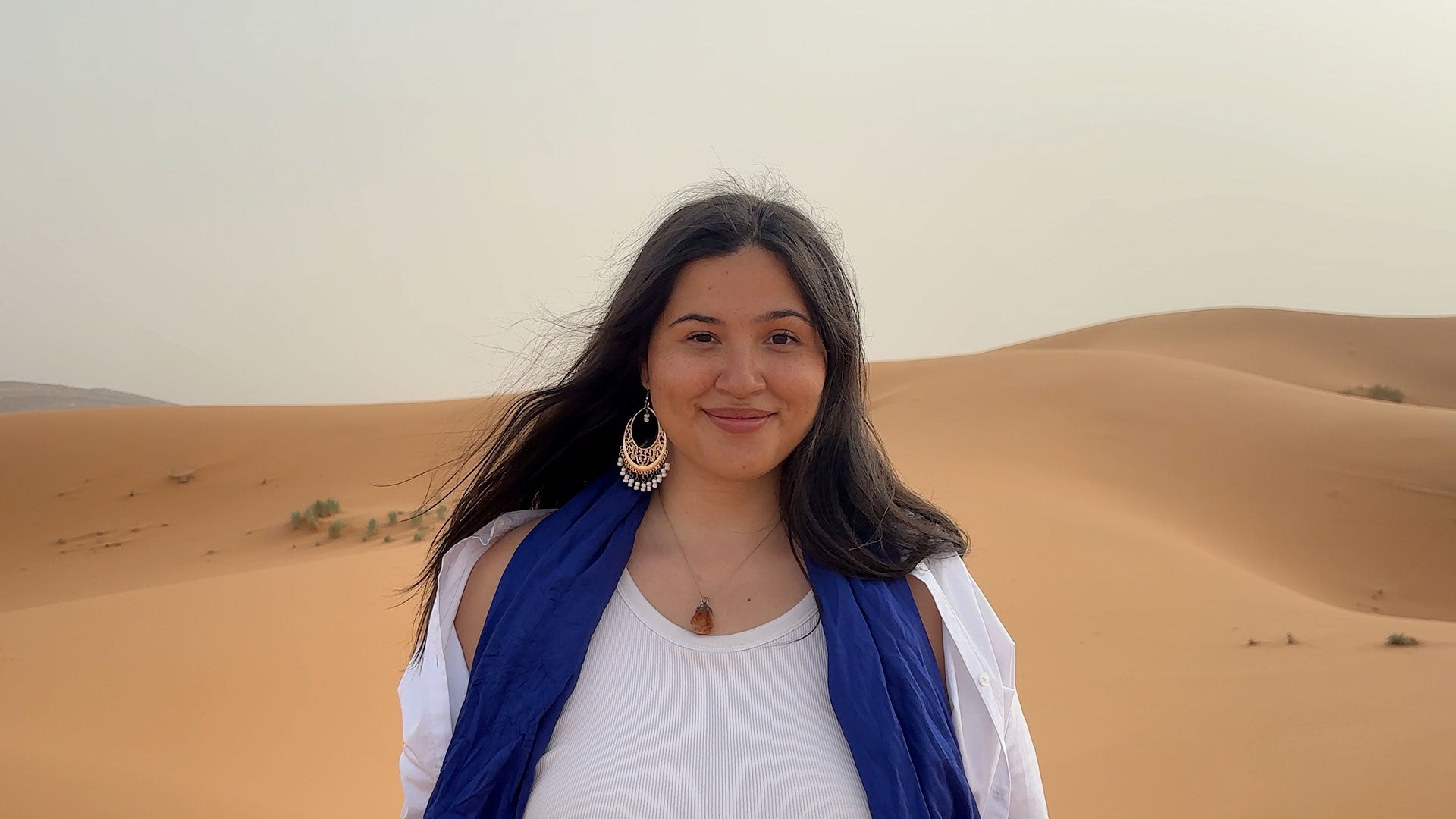
Maria Trujillo expanded her worldview by travelling while studying
Some say life is about the journey, not the destination. But for Maria Trujillo (Bachelor of Technology in Management (BTech) ’26) it’s been about both.
From the vibrant French countryside to sandy Saharan dunes, she backpacked across eight countries in the three years it took for her to complete the program.
In 2023, Trujillo chose the BTech program because the flexible online delivery would allow her to build on her previous Alternative Energy Technology diploma (class of ’20) and earn a degree while travelling.
“I didn't have to sacrifice one dream for another,” she says. “Often, it's either you go to school or you travel.”
Throughout the trip, Trujillo was able to apply what she was learning to what she saw and experienced. She gained knowledge not just in the virtual classroom, but through an enhanced perspective of herself, her potential and limitations, as well as the world, its people, and a deeper appreciation of her relationship to it all.
“I wasn't just an academic student,” she says. “I was learning about life as well.”
All of it, alongside her BTech degree, which focused on sustainability management, have encouraged Trujillo to become a consultant, and run her own business.
In June, Trujillo will return to where it all began to cross the stage at NAIT’s convocation. Along with her parchment, she will have passport stamps as proof of the lessons she’s learned.
Lesson 1: See beyond one worldview
The BTech program pushed Trujillo to challenge her own actions, assumptions and biases, and role in sustainability.
In her second year, she learned about the history of colonization and its impacts on modern economic systems in developing nations. Then she saw real examples of that outside her hostel window in Indonesia.
“It was a very surreal experience of, ‘I’m not just reading it, I'm living in it.’”
The amount of garbage on the streets stood out to her, and she considered the matter as a potential topic for her paper. She turned to locals for answers. But the bigger issue for them, Trujillo learned, was not being able to put food on the table.
She realized that her Western beliefs prevented her from looking at the issue through a broader, more empathetic lens. Messy streets can point to deeper and more important socioeconomic issues; that is, they can be a low priority for people in “survival mode.”
What’s more, Trujillo came to understand that travellers like her contributed to that problem.
The final year of her studies, Trujillo stayed in Seville, Spain, not just to stretch her budget, but to minimize her carbon footprint.
“I couldn't ignore those things school was teaching me. And knowledge is a responsibility.”
Lesson 2: Listen to understand and connect
Once Trujillo understood the biases she held, it became easier to connect with the people she met, wherever she was.
“My job was to shut up and learn from them,” she says. “It brought a lot of really cool conversations to the table.”
Her instructors encouraged her to continue those conversations. “They knew I had more in me to keep exploring, pushing me to be a better student, a better person.”
Interacting with local people gave Trujillo the chance to be part of the solutions communities actually needed. In Seville, she volunteered with an organization helping underprivileged people participate in sports, build camaraderie, and “take them out of their situation, show them a different path.”
Trujillo believes these kinds of experiences, and the skills she gains from them, will help her build her business as she continues to travel. She knows the only way to generate solutions is to put people first and ask questions.
“There’s not just one right answer,” she says.
“It’s about listening to the people whose problems you're [hoping to help] solve. What's their point of view? What are they struggling with? Put yourself in their position.”
Lesson 3: Persevere despite the challenges
Studying abroad came with challenges.
Sometimes, she had to wake up in the middle of the night to participate in a live lecture. More than once, Trujillo was frantically submitting major assignments in airports as she was about to board. Wi-Fi was a perpetual problem, particularly when she was working from her tent in the Sahara.
Despite those challenges – and perhaps in part because of them – Trujillo made the Dean’s List.
“It's been a life-changing experience,” she says. “It has shown me what I'm capable of, that I can build relationships wherever I go, and [see] the beauty of humanity.”
To celebrate that, Trujillo is returning to Canada to visit her family and attend NAIT convocation in Edmonton.
It will be the first time she meets her classmates in person; some are from the city, while others are from as far away as the United Arab Emirates.
Thinking back to her journey – the places she saw, the people she met – Trujillo wouldn’t change any of it for the world.
“What you really remember is those moments with people,” she says. “I just feel like I have little bits and pieces of my heart everywhere around the world.”
If you enjoyed that article, try these:
Northern Alberta Institute of Technology
Mailing Address:
11762 - 106 Street
Edmonton, AB, Canada, T5G 2R1
At NAIT, we honour and acknowledge that the land on which we learn, work and live is Treaty Six territory. We seek to learn from history and the lessons that have come before us, and to draw on the wisdom of the First Peoples in Canada. Only through learning can we move forward in truth and reconciliation, and to a better future together. Read more
About techlifetoday
Techlifetoday is the source for NAIT alumni and students to discover news about the polytechnic, and insights, advice and inspiration from the NAIT community to help them build successful careers and lead fulfilling lives.
