
Instrumentation Engineering Technology grad benefited from openness to opportunity
Kaden Van Domselaar (Instrumentation Engineering Technology (IET) ’26) was 18 years old and a week into his studies in Instrumentation Technology at NAIT when he said “yes” to his first extracurricular activity. The NAIT chapter of the International Society of Automation (ISA) needed new blood.
“I convinced myself: I’m already here so I might as well make the most of it,” he says.
“What’s the worst that could happen?”
Van Domselaar spent the next two years answering this question. His preference for saying “yes” saw him make the most of his time at NAIT. It took him to the presidency of the polytechnic’s ISA chapter, to Tokyo, to an engineering toboggan race, to the podium of an international student competition, and to the threshold of a promising career.
President in a hurry
Van Domselaar joined the NAIT ISA as the vice-president of communications, where his main responsibility was reaching out to refineries, plants and factories around Edmonton to organize tours for students. When the then-president graduated ahead of schedule, Van Domselaar became president-in-waiting.
A year later, he was the president of the club.
“It was really awesome,” he says. “I got to meet a ton of really cool people who I’ll probably know for the rest of my life.”
When he became president, Van Domselaar invited a group of his friends and peers to join, including Rachel Mogg (IET '26, Mechanical Engineering Technology '23), Danielle Olsen (IET '26), Alvin Topacio (IET '26) and Matt Imray (IET '26).
Together they organized the club to qualify for funding from the NAIT Students’ Association for the first time in years. They also kept organizing industry tours to places like the Labatt Brewery to observe automation’s industrial applications.
Across the Pacific
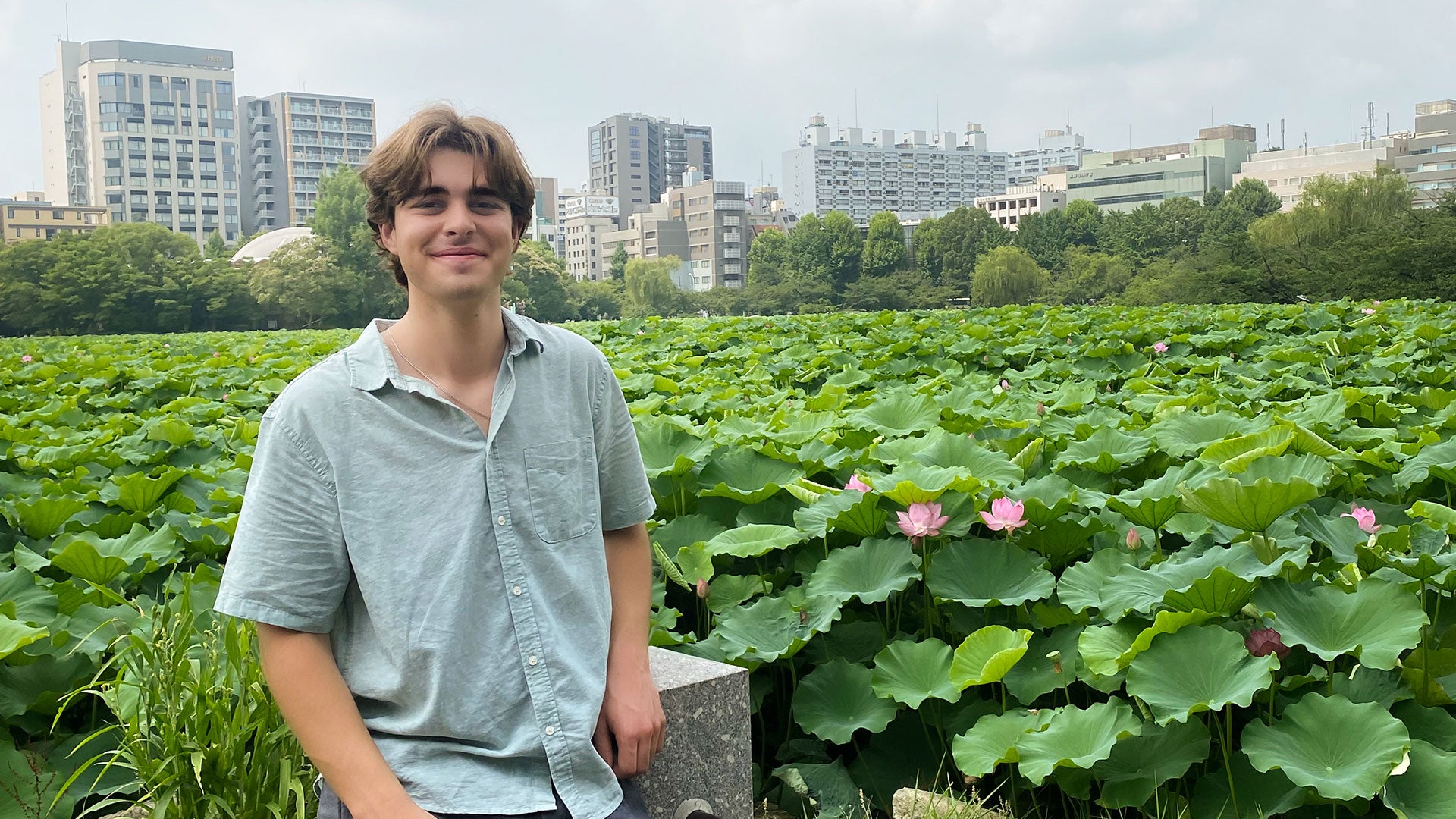
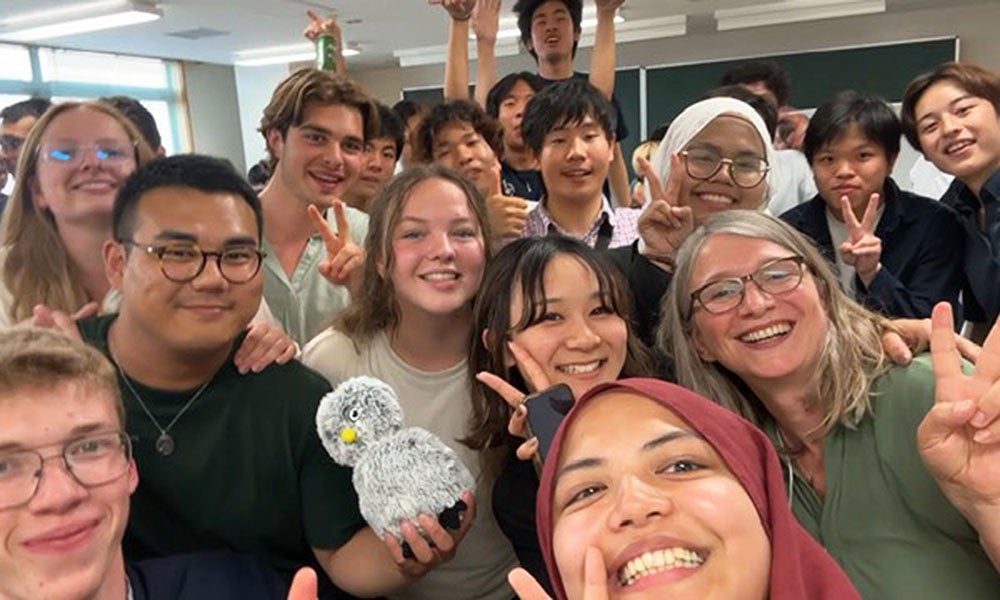
Van Domselaar’s penchant for “yes” later took him across the Pacific Ocean, when he joined a contingent of NAIT engineering technologies students on a 12-day trip to Japan.
After a few days in Tokyo, they spent most of the trip at the National Institute of Technology in Nagano.
“It was unbelievable,” he says. In addition to going to lectures and classes, the students visited restaurants and historical temples.
“It’s hard to describe how interesting and how much fun it was.”
When the plane landed in Edmonton, another student invited Van Domselaar on another trip: to London, Ontario in February, to race a concrete toboggan down a ski hill.
“I thought it would be a small commitment,” says Van Domselaar with a laugh. “It was not.”
Competitive by nature
The larger-than-expected commitment was to join a team competing in the Great Northern Concrete Toboggan Race, an engineering competition with roots stretching back to 1975. Teams from schools across North America design, build and race sleds with concrete skis. Each sled must carry five passengers and have a roll cage. It can’t weigh more than 350 pounds and needs steering and braking systems.
Over the years the event has evolved into more than a simple race. Teams document their design with lengthy reports. Sleds are tested for their braking power. Points are awarded for team spirit, costumes and cheers.
Van Domselaar designed the steering and suspension system for NAIT’s sled.
“I didn’t have any formal mechanical engineering training. I had to figure out a ton of stuff, ask a lot of questions,” he says. “But I would not have had it any other way.”
In the end, NAIT’s sled performed well. Out of a field of 19, it had the third-best brakes and made it to the semifinals. But time ran short on the ancillary stuff like the reports and costumes.
“But overall we did better than we expected,” he says.
Van Domselaar carried this positive outlook to another competition shortly before graduating. This time the results were different.
He teamed up with four other NAIT students to compete in the Industrial Automation Student Club International Student Games in March. Hosted by SAIT, the games attract students in automation from all over the world.
This year, the NAIT entrants were paired with students from Asia and Europe to complete four challenges.
“It was similar to what our labs were like during class but on a tighter timeframe, they were harder, and you had to do them with people you had to work hard to communicate with,” says Van Domselaar.
“It’s not meant to be deathly serious. But being me, I still want to win.”
Van Domselaar’s team scored 198 points. This was good enough for second place, earning him a shiny medal and many fond memories.
NAIT as a foundation
Van Domselaar will spend the summer working as a contractor for an instrumentation and controls company before returning to school in the fall when he enters the engineering program at the University of Alberta, taking advantage of a pathway between the programs that recognizes his diploma.
He’s not sure what branch of engineering he’ll pursue, but he is sure that he wants to combine the practical and theoretical in his career, and that NAIT has helped positioned him to do so
“The best engineers have always worked on the stuff they design,” he says. “There’s the trope of the car mechanic that hates the engineer because the engineer put the oil filter in an awkward spot.
“I want to change that.”
Wherever he winds up, Dr. Ana Stefanova expects he will thrive.
“He likes to learn and he’s not afraid to take on a challenge. He’s also very good at working with others,” says Stefanova, an IET instructor and associate chair.
“I think he will be successful in whatever he decides to do and wherever his passion takes him.”
When he arrives at the university this fall, Van Domselaar won't forget his time at NAIT.
“I’ve taken advantage of opportunities that have only existed because of NAIT’s place in the industry and my NAIT education,” he says. “All these things I owe to NAIT. So for that I’m very thankful.”
If you enjoyed that article, try these:
Northern Alberta Institute of Technology
Mailing Address:
11762 - 106 Street
Edmonton, AB, Canada, T5G 2R1
At NAIT, we honour and acknowledge that the land on which we learn, work and live is Treaty Six territory. We seek to learn from history and the lessons that have come before us, and to draw on the wisdom of the First Peoples in Canada. Only through learning can we move forward in truth and reconciliation, and to a better future together. Read more
About techlifetoday
Techlifetoday is the source for NAIT alumni and students to discover news about the polytechnic, and insights, advice and inspiration from the NAIT community to help them build successful careers and lead fulfilling lives.
