
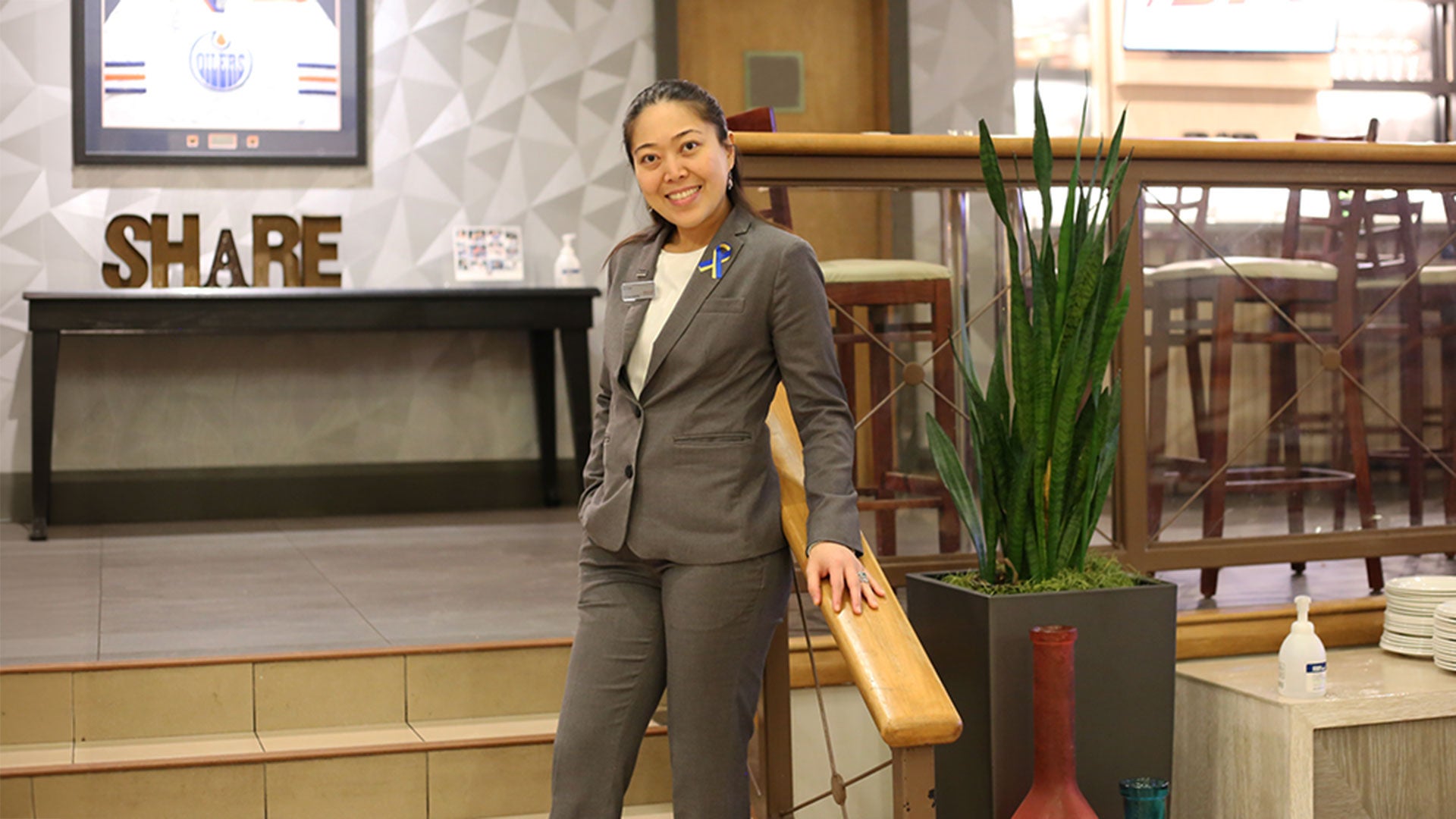
Cinema program helped Jo Miraflor-Mailman finds her place as a producer
Jo Miraflor-Mailman’s dreams told her that she needed a change. Eventually, she listened.
Born in Cebu province in the Philippines, Miraflor-Mailman (Digital Media and IT – Narrative Cinema Production ’26) worked in hotels in Dubai, Abu Dhabi, Morocco and Edmonton, where she moved in 2015 and later came to work at the Westin Hotel downtown.
“I would stand behind the front desk, behind these wide glass windows, and daydream about the people outside,” says Miraflor-Mailman. “Especially if I saw people talking, I would imagine the conversation and make a script. And the voice inside my head was always ‘You’re a storyteller, Jo. Make stories.’
“I realized I needed to do something different.”
Miraflor-Mailman looked at cinema production education available near Edmonton. NAIT’s program enticed her.
But change can intimidate anyone. Miraflor-Mailman counted her reasons to stay put. She was 40 years old. She had an established career. She’d recently received a clinical diagnosis for ADHD. She hesitated and waited.
“Finally, my friend Charina said, like a kick in the butt, ‘Girl, you’ve been talking about this for two years,’” says Miraflor-Mailman with a laugh. “‘You could have already finished the program by now!’”
So she enrolled at NAIT.
“I came with a mindset that I am working on a two-year contract,” she says. “I never looked at it as class or being a student. I thought, ‘I am working for two years. I am an apprentice.’”
Her studious, focused approach was soon noticed.
The power of the producer
NAIT’s Narrative Cinema Production program introduces students to every aspect of film production, from camera operation to directing to budgeting. When Miraflor-Mailman started, she thought she wanted to become a film editor. Instructor Zac Hogle thought otherwise.
“Jo had producer written all over her from moment one,” he says. “Producing, when you’re in the industry, is one of the more desirable jobs. But when you’re in school, it’s a big job.”
It’s also an overlooked and often misunderstood job, despite it being essential to successfully completing a project.
“My peers wanted to be directors, writers, video editors or camera operators. Nobody wanted to be a producer,” says Miraflor-Mailman. “What does a producer do? I learned that the things a producer does, I already have skills for. Paperwork, talking to people, managing people in a team – the hospitality part.
“I realized this comes naturally for me.”
Her production skills quickly earned her a reputation among her peers, who asked her to work on their projects. These were exclusively thrillers and dramas.
“It was all very seriously themed,” says Miraflor-Mailman. “By the summer of that year, I needed a palate cleanser. I need something light.”
So she made it.
In a class on sourcing new ideas for film production, Miraflor-Mailman wrote The Rosemont and pitched it to her instructors.
“We get a lot of interesting pitches but not many that are so ready,” says Hogle. “Jo’s was one of the most ready-to-go pitches I had ever heard. This was a real pitch you would see at the Banff Media Festival. This is something that should get made.”
Miraflor-Mailman describes The Rosemont as “a workplace comedy where Superstore meets The Office.”
It draws liberally from her experience working in hospitality. Though the tone is light, Miraflor-Mailman aims to address themes like the immigrant experience and intergenerational trauma.
“The day after convocation is my first class for standup comedy,” she says. “I have enrolled in a class to brush up on how to write comedy for The Rosemont, and I think I’m good at turning really serious themes into ridiculous moments so they become funny in the ‘funny because it’s true’ way.”
Protecting the magic
Before she graduated, Miraflor-Mailman founded a production company, PassionFilms Media. Her first project is a “vertical video” version of The Rosemont designed to be watched on smartphones and entirely self-funded.
She plans to use it in her pitch to possible funders like CBC and Netflix, and to build an audience for the eventual big-screen version.
“I call this my trans-media plan,” says Miraflor-Mailman.
“I start with a small screen and the audience connection is strong. Then when I’m pitching, I have a proof of concept: ‘I have an audience, this works, so give me the money!’”
Miraflor-Mailman takes a similar step-by-step approach to funding PassionFilms Media, which she plans to do with seasonal work as an insulator. She encountered the idea through a friend she met while working in hospitality and who now works in the trade herself.
“I want to protect the magic I found in the world of film,” she says. “Making film, even a short one, is very challenging, but still magical. If I have a 9-to-5 job that is project-based, I’ll work for five or six months straight and then spend the rest of the year on film.”
Producers need many skills. The most important might be persistence.
“It’s the ‘keep going’ industry,” says Hogle. “It’s 80% hearing no. If the first 10 pitches are all ‘no,’ the key for Jo is to keep going. I feel that [her] project will get a ‘yes’ and it’s just a matter of when.”
Miraflor-Mailman feels a sense of destiny about The Rosemont and her future in film.
“If I went to school for filmmaking in my 20s, I don’t think I would fall in love to the extent that I want to protect the magic,” she says.
“I feel like I’m just starting, I’m just beginning. I have so many ideas. I feel like I am where I am supposed to be.”
If you enjoyed that article, try these:
Northern Alberta Institute of Technology
Mailing Address:
11762 - 106 Street
Edmonton, AB, Canada, T5G 2R1
At NAIT, we honour and acknowledge that the land on which we learn, work and live is Treaty Six territory. We seek to learn from history and the lessons that have come before us, and to draw on the wisdom of the First Peoples in Canada. Only through learning can we move forward in truth and reconciliation, and to a better future together. Read more
About techlifetoday
Techlifetoday is the source for NAIT alumni and students to discover news about the polytechnic, and insights, advice and inspiration from the NAIT community to help them build successful careers and lead fulfilling lives.
