

CEO and NAIT grad Myron Keehn oversees start of $300M, 2,000-acre cargo hub
Myron Keehn (Accounting ’92) understands how most people see airports. To travellers, they’re liminal spaces between departure and arrival. We like them if they’re attractive and modern, have good snacks, and are efficient.
That understanding has been rewarded. As president and CEO of Edmonton International Airport (YEG), Keehn was pleased to see 8.14 million passengers served in 2025, up 2.4% over 2024. That’s the most since the pandemic, making this Canada’s fifth-busiest airport.
But Keehn views YEG as responsible for helping more than just travellers take flight.
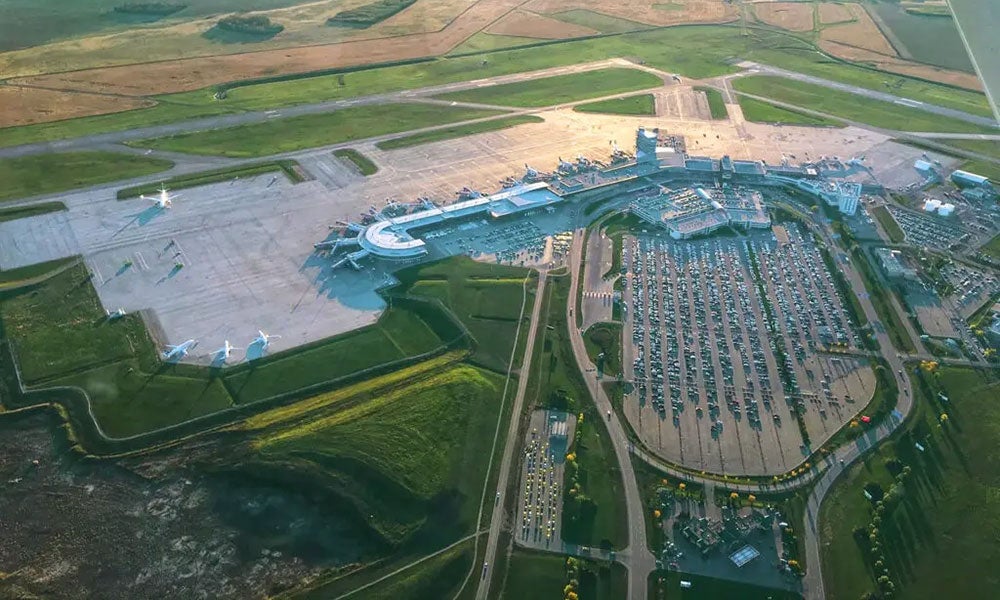
“Aviation is an enabler of growth,” he says, seated in his fifth floor office in the airport’s Gaudí-esque central tower. One direction looks onto a long row of planes at gates, the other at a giant grid of parked cars. Together, they only hint at the vastness of the airport’s 28-square-kilometre footprint, twice that of the nearby town of Devon.

That footprint may be an enabler of Keehn’s goal for YEG specifically: After ensuring safety and security, “our mission is to enhance the prosperity of the region we serve.”
To deliver on that, ground was broken in May on a 2,000-acre, $300-million cargo hub, a high-tech warehouse district with a landing strip the likes of which the Edmonton area, and even most of the country, has never seen. It’s a “build it and they will come” project backed by $100 million from the federal government.
There’s risk, of course, but the only real gamble Keehn sees is in not bringing the hub, years in the making, to fruition.
A massive inland port
While offering little low-hanging fruit owing to the high-cost of entry, the industry may still be ripe with opportunity. The current value of the global air cargo market is more than US$170 and growing at about $6.4%. Overall, roughly a third of the world’s goods by value move by air.
In 2024, Canada’s share sat at $8.69 billion (then US$6.39 billion), and was growing at 6.1%.
Keehn sees Edmonton as ideally situated to stake its claim – which it previously hasn’t. The region is no national mecca for cargo, eclipsed by the likes of Toronto, Vancouver, and even well below Calgary’s capacity. In fact, Edmonton has been among Canada’s lower cargo handlers by volume.
But, “if you had to pick a spot on a map, it couldn't be better located,” Keehn says, noting the myriad international flights that pass directly over. “We have an opportunity to attract those flights,” he adds, and stuff their underbellies with freight.
Then there’s terrestrial transport. The city is the first place the CN and CP railways meet after departing West Coast ports of Prince Rupert and Vancouver, Keehn points out. “Edmonton is one massive inland port.”
For what? The list includes virtually any supplies for local manufacturing, or outgoing commodities ranging from honey to pork to pharmaceuticals, along with anything those local manufacturers produce.
“It's like a hockey stick,” says Keehn. Currently, “we're at the very top of the blade. But … the volume is going to start to dribble in and then it's going to take off like it's moving up the shaft.”
At least, that’s the flight plan from ground level. But, whether or not it’s ready for takeoff, the plane has left the hangar.
Connecting Alberta to the world

Construction on the cargo hub (pictured in the rendering above) is underway after years of planning and engineering. “They are moving at a pace I've never seen,” says Keehn.
Besides its warehousing capacity, the project calls for technology, much of it cutting edge. For example, instrumentation will ensure that planes can even land safely in low visibility, essentially autonomously. And inground systems will facilitate rapid refuelling.
“We'll be able to handle eight or 10 widebody aircraft at the same time,” says Keehn.
It’s two years away from taking aircraft. In the meantime, the project is expected to create 800 construction jobs and 250 permanent airport positions. For government backers, that boost – and the potential increase in market access at a time of differences with the U.S., traditionally our largest trading partner – is worth the expense.
“We are increasing trade capacity by connecting Alberta’s goods to customers across Canada and around the world,” said Hon. Steven MacKinnon, federal Minister of Transport, in a release issued for the groundbreaking.
“We are building a more efficient and competitive transportation network that works for all Canadians.”
Dollars and cents, arrivals and departures

Dr. Richard Ford likes what he sees in that network so far. With a previous career as a customs officer, the JR Shaw School of Business instructor has helped develop curriculum for its Supply Chain Management degree and new diploma program. Once, Ford even occasionally worked in a federal office at YEG.
Like Keehn, he appreciates the hub’s location, and at a granular level, noting its strategic highway access.
“You could change the mode of transportation quite easily,” he says. “You could do what's called intermodal, where [cargo] comes in by air and then goes out by truck, or comes up by rail and then goes out by air.”
Ford also sees the bigger picture, with the hub catalyzing development beyond the borders of the airport. “There's a lot of possibilities on freight,” he says.
For example, better access to both incoming supplies and markets outside Alberta could make the region more appealing to manufacturing, a sector that accounts for about 10% of Canada’s GDP but only about 7.5% of Alberta’s.
In that respect, a robust cargo hub could prove to be “a reason to locate in the Edmonton area,” says Ford.
And Keehn may be ideally suited to see it through.
He acknowledges the CEOs before him as laying the foundation for the project (Keehn has held the job since Jan.1, 2023), but airports have fascinated him for years. He put what he sees as the “practical, real-world experience” of his NAIT education to work in management and director roles with the Vancouver Airport Authority for a decade, then spent almost 10 years more in Edmonton leading business, land and commercial development.
“If you like business that’s dynamic, evolving [and] challenging, aviation is a perfect market to get into,” says Keehn.
“We’ve never been more mobile than we are now. Aviation has enabled that. Think about what that has done for economic development.”
As an accountant, Keehn thinks about that a lot. In fact, he suggests that every dollar invested in the hub (and, being a not-for-profit corporation, YEG reinvests everything) could spin off about $340 in community benefits.
But, as CEO of an organization that remains, above all else, responsible for safely moving human beings, there are times when those numbers take seats at the back of the plane. Airports are frenetic spaces. But, here and there along the concourse, the speed slows for aspects of being human.
Keehn sees that every day. Someone dabs tears while watching a plane lift off. An elderly couple beams at their new grandchild for the first time. A couple shares a long embrace, one wearing military fatigues. All are oblivious to the multimillion-dollar hub their travel is making possible.
“It’s addictive,” Keehn says of the job. “It’s so much more than just the dollars and cents. You’re part of something that’s bigger than yourself.”
If you enjoyed that article, try these:
Northern Alberta Institute of Technology
Mailing Address:
11762 - 106 Street
Edmonton, AB, Canada, T5G 2R1
At NAIT, we honour and acknowledge that the land on which we learn, work and live is Treaty Six territory. We seek to learn from history and the lessons that have come before us, and to draw on the wisdom of the First Peoples in Canada. Only through learning can we move forward in truth and reconciliation, and to a better future together. Read more
About techlifetoday
Techlifetoday is the source for NAIT alumni and students to discover news about the polytechnic, and insights, advice and inspiration from the NAIT community to help them build successful careers and lead fulfilling lives.
