
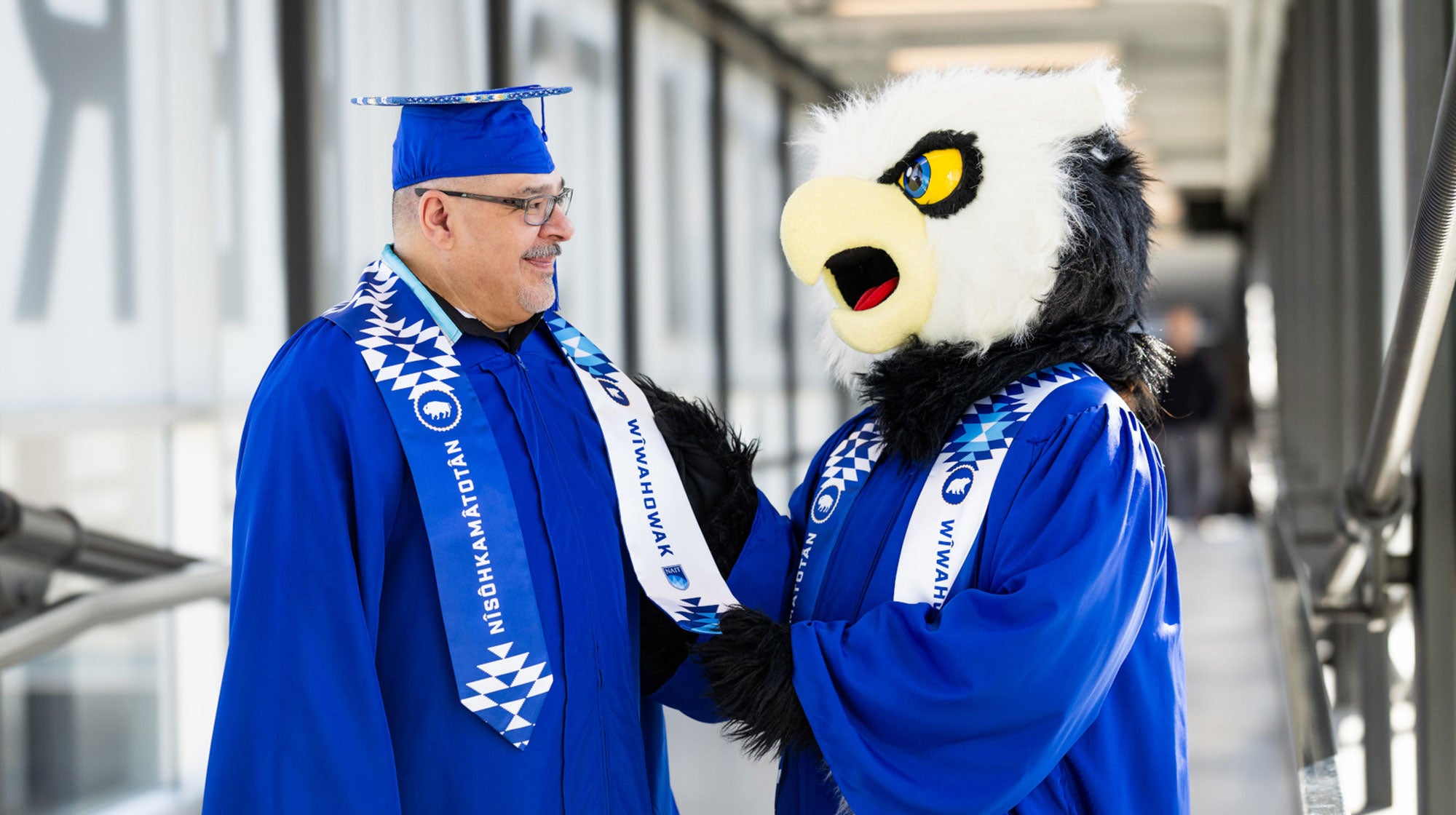
Custom-designed garment symbolizes identity and success
After 39 years in the energy industry, mostly in Indigenous relations in northern Alberta, Peter Knight (Professional Meat Cutting and Merchandising ’26) decided to retire. Well, almost.
His wife was in a similar position, wrapping up a career as a human resources manager. But neither wanted to stop working altogether; they just wanted a change.
“She’s always wanted to be a chef,” says Knight, who’s 59. “I said, ‘I'll be a butcher if you want to be a chef.’ So we went back to school, and totally enjoyed the programs.”
From a farm-to-table perspective, Knight’s choice made sense: he cuts it, she cooks it. But his decision was also rooted in culture.
“The thing with our Indigenous communities is we like to feed our people,” says Knight, originally from Fort Chipewyan, a hamlet north of Fort McMurray reachable only by boat or plane in summer, and ice-road in winter. He’d like to return to show young hunters what he’s learned.
“This is what you could do when you down a moose, when you down a deer,” Knight says.
Those skills, that knowledge and the potential to share are just a few of the reasons he’s excited about convocation. But it’s not just crossing the stage that he’s looking forward to – it’s how he’ll cross the stage. In June, Knight will join the first cohort of Indigenous students to wear a specially designed, traditionally inspired stole at NAIT’s convocation.
“It’ll be a chance to showcase our identity as Indigenous people – to stand out,” he says, “as we should.”
Highly symbolic
The creation of the stole began with a Cree word: wȋwahowak.
“It literally means ‘gather your things,’” says Kaitlyn Menard, Indigenous liaison specialist with the Nîsôhkamâtotân Centre, a gathering place for Indigenous and other students at NAIT.
That is, it’s about moving on, she adds, referring to packing up one camp and heading to another with the change of seasons. The word was suggested by Lonny Potts, cultural adviser with the centre, who was ceremonially offered tobacco for his contribution to the project, which Menard led on behalf of the centre.
“In this context,” she says, “it means to finish up a journey here [at NAIT] and continue on to the next one.”
In collaboration with Menard and other staff at the centre, NAIT graphic designer Travis Masyk (Graphic Communications ’09, below) designed the stoles. “I feel very honored to work with them because I'm a Métis man, myself,” says Masyk. “I was born and raised up north, in High Prairie.”
Hanging roughly to the waist of the wearer like parallel neckties, the stole features the blues and whites of the NAIT shield. It’s also highly symbolic. Its traditional triangular patterns, for example, “double as peaks and valleys,” says Masyk, “which is a student's journey.”
He was also deliberate about including certain sacred animals. The buffalo on the right strand stands for respect and resilience, says Masyk, and the bear on the left for strength and courage – ideal traits, he felt, for grads facing exciting yet unknown futures.
Overall, Masyk wanted to strike a balance between academic achievement and a celebration of identity that would demonstrate that students “don't have to leave their culture at the door” when they study at NAIT.
“This is a way to show your pride,” says Menard.
At convocation, where hundreds of students will gather from across the polytechnic, and from myriad places and backgrounds, Indigenous grads can represent themselves if they so choose.
“In that sea of blue, this is a little something extra. It shows off who you are in a public way.”
“You can do it”
Knight hopes that show of identity also inspires. He knows that life circumstances can make the prospect of post-secondary seem daunting. In his case, he was one of a small group of mature students in a cohort dominated by those in the early 20s.
“A lot of them could be my grandkids,” Knight jokes.
Yet he’s now beginning a second career. Knight has already landed a job as a butcher in the meat department of a major grocery chain, having had multiple offers. To him, the stole is a symbol of that success – a success he sees as accessible to others.
“I think it'd be really culturally significant to show young kids that, yeah, you can do it,” says Knight of adding the stole to his graduation gown. “It doesn't matter what stage of life you're in, you follow your dreams and you can make stuff happen, right? And I think NAIT was a huge part of me being successful.”
Masyk likes the idea of having contributed to Knight’s ability to encourage others. He also likes the possibility that putting on the stole may give grads all the more reason to pause and consider their accomplishment. Wȋwahowak is about more than just preparing to move on. It’s about taking stock of what you’ll carry forward with you.
“We are a proud people and I think it's great to show that off,” says Masyk. “[During] something as meaningful as convocation, I think it’s huge to celebrate your community and your ancestors.
“You know, that's how you got here.”
_____________________________________________________________________________________________________________________
And blankets to match
In addition to the stole, NAIT designer Travis Masyk designed blankets that were given as gifts to students who attended “Honouring your Success.”
Hosted by the Nîsôhkamâtotân Centre, the annual event recognizes the efforts of Indigenous students from across the polytechnic. April marked the first time it was held in Ernest’s, NAIT’s on-campus fine-dining restaurant.
Northern Alberta Institute of Technology
Mailing Address:
11762 - 106 Street
Edmonton, AB, Canada, T5G 2R1
At NAIT, we honour and acknowledge that the land on which we learn, work and live is Treaty Six territory. We seek to learn from history and the lessons that have come before us, and to draw on the wisdom of the First Peoples in Canada. Only through learning can we move forward in truth and reconciliation, and to a better future together. Read more
About techlifetoday
Techlifetoday is the source for NAIT alumni and students to discover news about the polytechnic, and insights, advice and inspiration from the NAIT community to help them build successful careers and lead fulfilling lives.
