
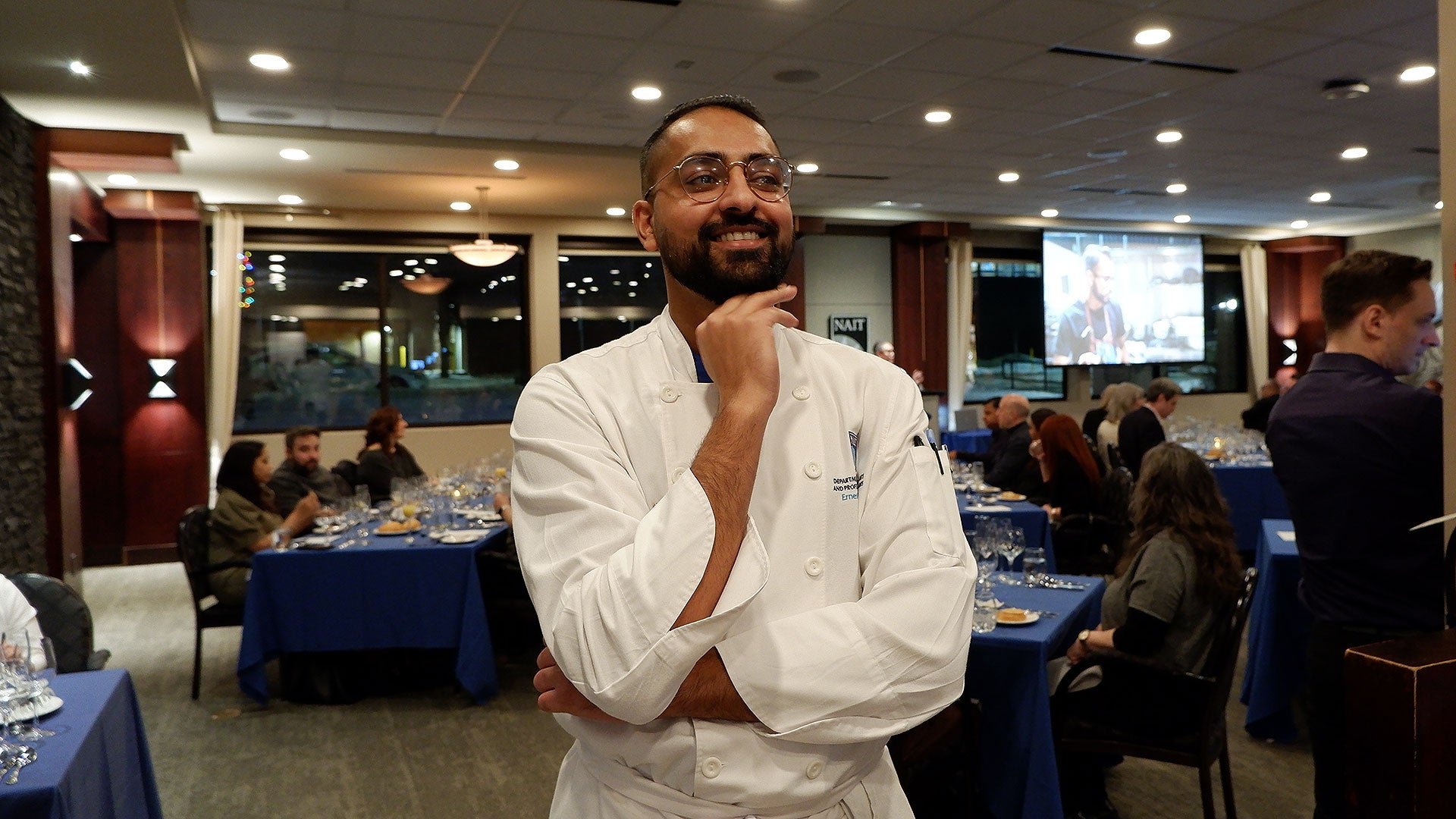
After successful pop-up, Shariff Rajpar reflects on culture, cooking and connection
It’s hard to believe that Shariff Rajpar (Culinary Arts ’17) was ever uninterested in Indian cuisine.
“When I was younger, I didn’t want anything to do with it,” the chef says. His parents were born in Tanzania, home to a large population of Indians, many of them descended from ancient traders from the subcontinent. His mom’s cooking focused on the country’s traditional dishes. “It’s something I grew up on.”
His aversion persisted from Grade 8 culinary class at Londonderry School through to studying at NAIT. “I just wanted to do classically French [cooking].”
In many ways, those days are over. Rajpar is now nearly 30 years old. “As I've grown up and I've had an appreciation for learning about myself and my family and my culture, I want to get back to my roots and to cooking what I love and know.”
Today, that desire is helping to build his career, as he explores – and often reinvents – the flavours of his childhood.
In January 2025, Rajpar was the youngest chef yet to lead one of Ernest’s sold-out Alumni Series Dinners, which bring grads back to the on-campus restaurant to stage single-evening, multi-course meals. In addition to that, his latest pop-up venture, an experiment in Indian-ramen fusion held at Menya Mori, sold out within an hour.
While the part-time NAIT instructor may attribute this success to the support of colleagues, friends and family, they’re not the sole reason. His success owes as much to how he embraces what he sees as the power of his profession to forge emotional, and often cross-cultural, connections.
“Food is so beautiful to me,” says Rajpar. “It's like music: a universal language. I love eating, I love tasting, I love witnessing that a-ha moment for people. The ability to trigger someone's memory or nostalgia from a smell, a taste, a [texture] – I think that's a really underrated quality that chefs possess.”
Evocative and inquisitive
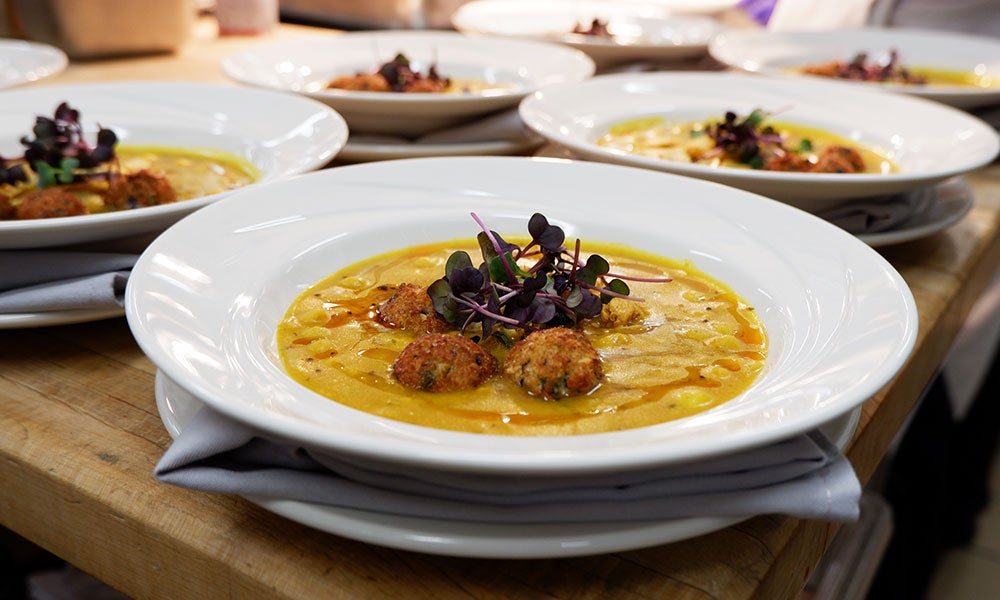
Over his two days at Menya Mori, May 10 and 11, Rajpar fed roughly 240 people. “The pop up went very well,” he says. “Certainly better than I could imagine.”
The meal comprised three courses. The first was his take on papdi chaat, an Indian street food. It featured spiced potatoes and chickpeas over coconut yogurt, garnished with a mint chutney, tamarind chutney and fresh pomegranate.
Chicken tandoori ramen accompanied in tandem as the second course. “You have this cooling bowl of yogurt that's a little sweet, spicy, umami that you eat with your ramen,” says Rajpar.
Dessert was mango-saffron basque cheesecake, enhanced with a crumble of pistachio and iconic Parle-G Indian cookies. Staff at Menya Mori, including owner Allen Goa, supported throughout, Rajpar notes. “It was great to work with a team that loves what they do, and I think that showed up in our bowl as well.”
While his alumni series dinner was a clear homage to his mom’s repertoire – the pop up was decidedly experimental. Rajpar sees it as the most successful of his three restaurant takeovers so far, largely for what he learned from balancing the flavours of two distinct cultures.
But perhaps its success lies in what others learned as well. The fusion generated discussion among diners about the dishes, says Rajpar, who viewed their curiosity as a desire to understand. When he was a NAIT student, one of his favourite courses focused on international cuisine. The food served as an entry point to a region’s history, religion, culture and people. It offered the potential to broaden the mind as well as the palate.
Rajpar didn’t intend for his ramen pop-up to be instructional; it was designed to be delicious. But its thoughtfulness and complexity wasn’t simply for show, either.
“When you're able to empathize with someone, I think that's really important to everyday life,” says Rajpar. “So if we can teach that from a cooking aspect, you know, why not?”
French curry
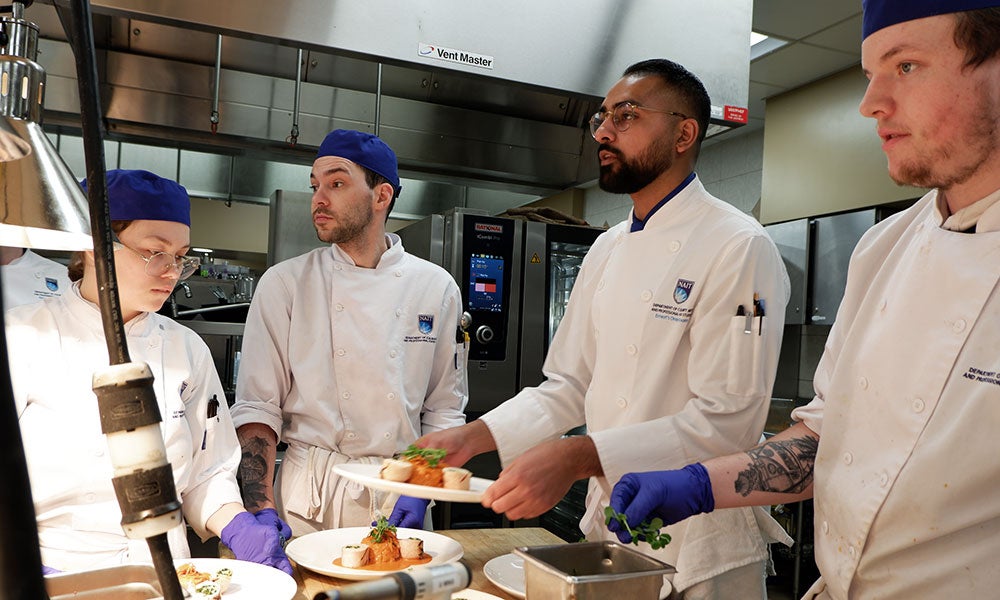
“Food is everything we are,” said the late writer and chef Anthony Bourdain, one of Rajpar’s culinary idols. “It’s an extension of nationalist feeling, ethnic feeling, your personal history, your province, your region, your tribe, your grandma.”
Rajpar intends to keep exploring those origins as he shapes his career. “I believe I still have lots to learn,” he says. “Culinary is one of those things you can never know enough [about].”
To advance that learning, he’s a line cook at the lauded Fu’s Repair Shop. He looks forward to imagining future pop-ups, maybe even a restaurant concept. And he hopes to reengage with culinary students at the polytechnic this fall, encouraging their own culinary explorations, and to continue learning from fellow instructors. “Being at NAIT is a privilege,” he says.
In the meantime, he’s not averse to engaging with a home-cooked Indian dish, but with a twist.
“When I cook my curries, it's way different than how my mom does.”
Mom cooks it all at once in a single pot. Rajpar’s process derives from the French foundation of his NAIT education. He starts by sautéing the aromatic vegetables and toasting the spices, bringing out the flavour. That mix comes out and then he cooks the protein, likely chicken. Then he recombines.
To build on Bourdain, that approach is an extension of who Rajpar is as a chef, and of everything that has gone into that. It’s a way to highlight different cultures while simultaneously connecting them. And it’s what will happen every time he’s in charge of making the curry. But that’s a job he’s willing to leave to the expert when he goes home for the kind of meals he had as a kid.
“My mom's will always be the best,” says Rajpar. After all these years, “it’s really what inspires my cooking.”
If you enjoyed that article, try these:
Northern Alberta Institute of Technology
Mailing Address:
11762 - 106 Street
Edmonton, AB, Canada, T5G 2R1
At NAIT, we honour and acknowledge that the land on which we learn, work and live is Treaty Six territory. We seek to learn from history and the lessons that have come before us, and to draw on the wisdom of the First Peoples in Canada. Only through learning can we move forward in truth and reconciliation, and to a better future together. Read more
About techlifetoday
Techlifetoday is the source for NAIT alumni and students to discover news about the polytechnic, and insights, advice and inspiration from the NAIT community to help them build successful careers and lead fulfilling lives.
