
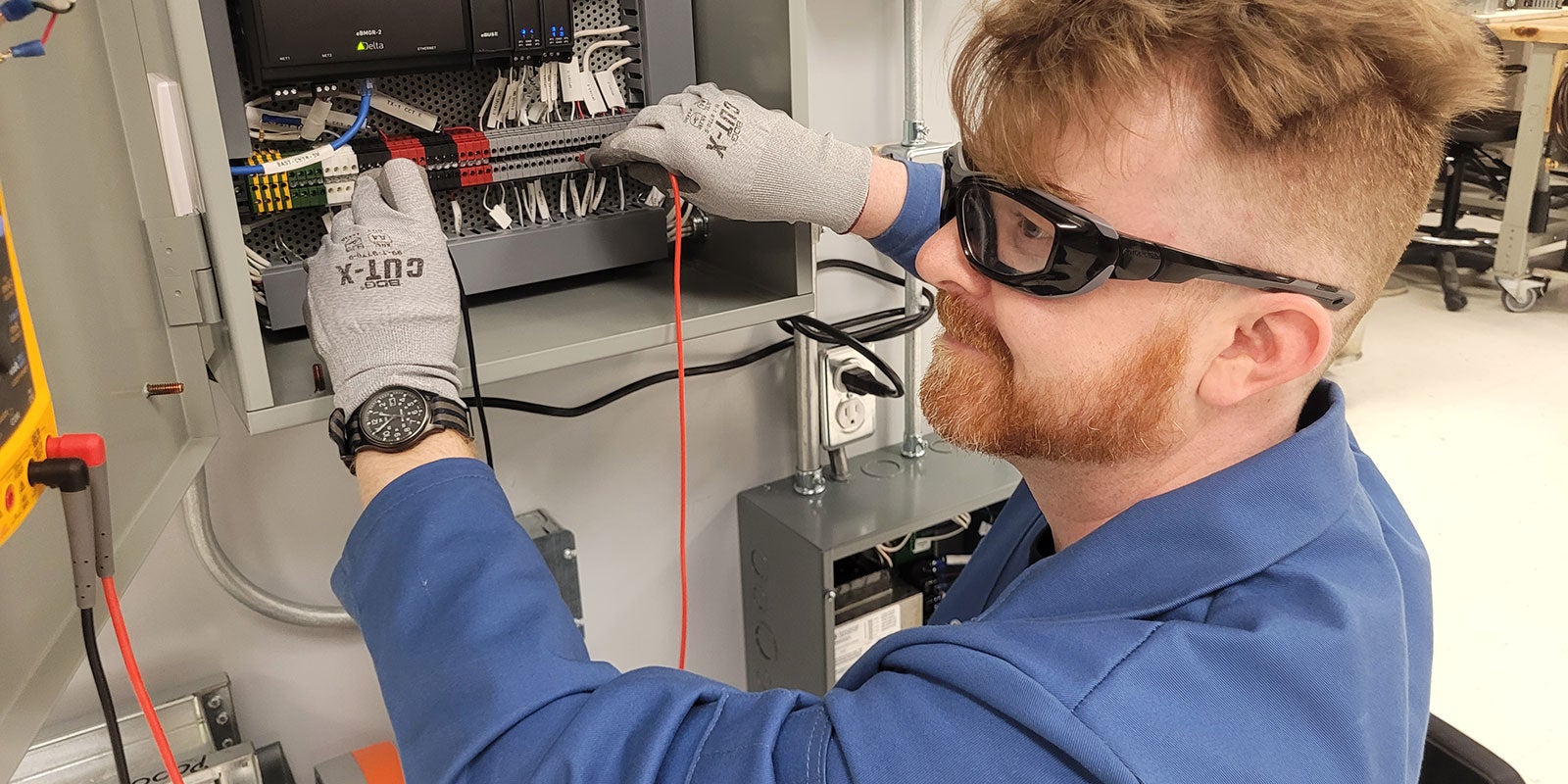
NAIT dean illustrates value of investment in hands-on skills on CBC Radio
Six billion dollars is an amount big enough to seem abstract. But government funders mean for it to have a tangible impact across Canada, including in Alberta.
April marked the launch of “Team Canada Strong,” a federal program that will put that sum to work in recruitment, education and hiring of 80,000 to 100,000 red seal skilled trades workers – those certified to national standards – in the next five years.
The current labourforce is aging, and ready to hand off even more billions of dollars worth of projects to the next generation to start or complete.
How will that handover be successful in Alberta?
Matt Lindberg-Fowlow (Plumber ’01), dean of NAIT’s School of Construction and Building Sciences, appeared on the May 6 episode of Alberta at Noon to respond to callers’ questions and comments.
Interest in apprenticeship is on the rise, he noted: 2026-27 enrolment in the 26 trades programs at the polytechnic is up 8% over last year, for a total of almost 13,000 students.
But meeting the long-term need will require a sustained, unified effort. Here are some of the insights Lindberg-Fowlow shared during the episode, such as work still needing to be done, myths in the process of being dispelled, and signs of hope – including the impact of additional support coming from the Alberta government.
---
Trades are reaching a new generation
“We’ve seen a big shift in helping folks identify [skilled trades] career paths early in their journey. There are a number of initiatives at NAIT. Next in Trades and Jill of all Trades invite junior high students to come onto campus and connect with [teachers], alumni, and students in the programs to help [them] understand what [the] opportunities might look like.”
---
The opportunities are there

NAIT dean illustrates value of new investment in hands-on skills on CBC Radioz
“We have a department called the Office of Apprenticeship that brings in industry folks who are looking to recruit, and helps to connect them with folks who are … finishing their first period apprenticeship and [don’t] have an employer lined up.”
---
The stigma is subsiding

“We have encountered a lot of stigmas around pathways into trades. Often [career] councillors would advise students who were academically successful to move into pathways besides apprenticeship.
“Part of it is a lack of understanding – [the apprenticeship system] can be complex. We’ve been … helping to educate those councillors [about] pathways into apprenticeship and what an apprenticeship career and journeyperson credential can afford folks.
“We’re starting to see that shift. [There is] really a lot of interest to understand more on how to create pathways for students who are going through the K-to-12 system, especially in the junior and senior high school years, and give them an [understanding of] what a career in the skilled trades could look like.”
---
There are (so many) choices

“[MyTradesecrets] has the entire suite of all apprenticeship programs that are available within the province. It also highlights the ones that are red seal eligible. There’s information around the forecasted … demand for those trades, as well as annual salaries.”
---
Journeypersons bring value to industry

“There’s lots of value in being able to bring additional insights and knowledge into an organization to help [it] be more successful. [With a] journeyperson, there are skill sets that are more technical but also thinking outside of the box and [awareness of] new technologies.
“We’ve been working with industry to help them understand that there’s an advantage to bringing those folks in because it … helps to introduce apprentices into your culture of safety and performance.”
---
The Province is backing trades at NAIT (in a big way)

“The Government of Alberta is certainly paying attention to what is going to be needed … to support that skilled labour requirement. [It] is also investing in significant infrastructure initiatives, including the Advanced Skills Centre, [a facility now under construction that] is … going to help support graduates of apprenticeship programs in the Edmonton region for decades to come.”
If you enjoyed that article, try these:
Northern Alberta Institute of Technology
Mailing Address:
11762 - 106 Street
Edmonton, AB, Canada, T5G 2R1
At NAIT, we honour and acknowledge that the land on which we learn, work and live is Treaty Six territory. We seek to learn from history and the lessons that have come before us, and to draw on the wisdom of the First Peoples in Canada. Only through learning can we move forward in truth and reconciliation, and to a better future together. Read more
About techlifetoday
Techlifetoday is the source for NAIT alumni and students to discover news about the polytechnic, and insights, advice and inspiration from the NAIT community to help them build successful careers and lead fulfilling lives.
