
Tradition started in 1975 continues to build relationships that span years
Relationship building – more than engineering – at heart of annual event
For decades, NAIT Construction Engineering Technology students have faced the possibility that full participation in the program may mean getting soaked. But most have embraced that. Overall, the benefits have outweighed the risk of an early autumn dip in Edmonton’s Whitemud Creek.
On Sept. 27, 2025, roughly 130 students, instructors and industry members (including some alumni) will take their chances once again in the bridge building competition, an annual tradition celebrating its 50th anniversary.
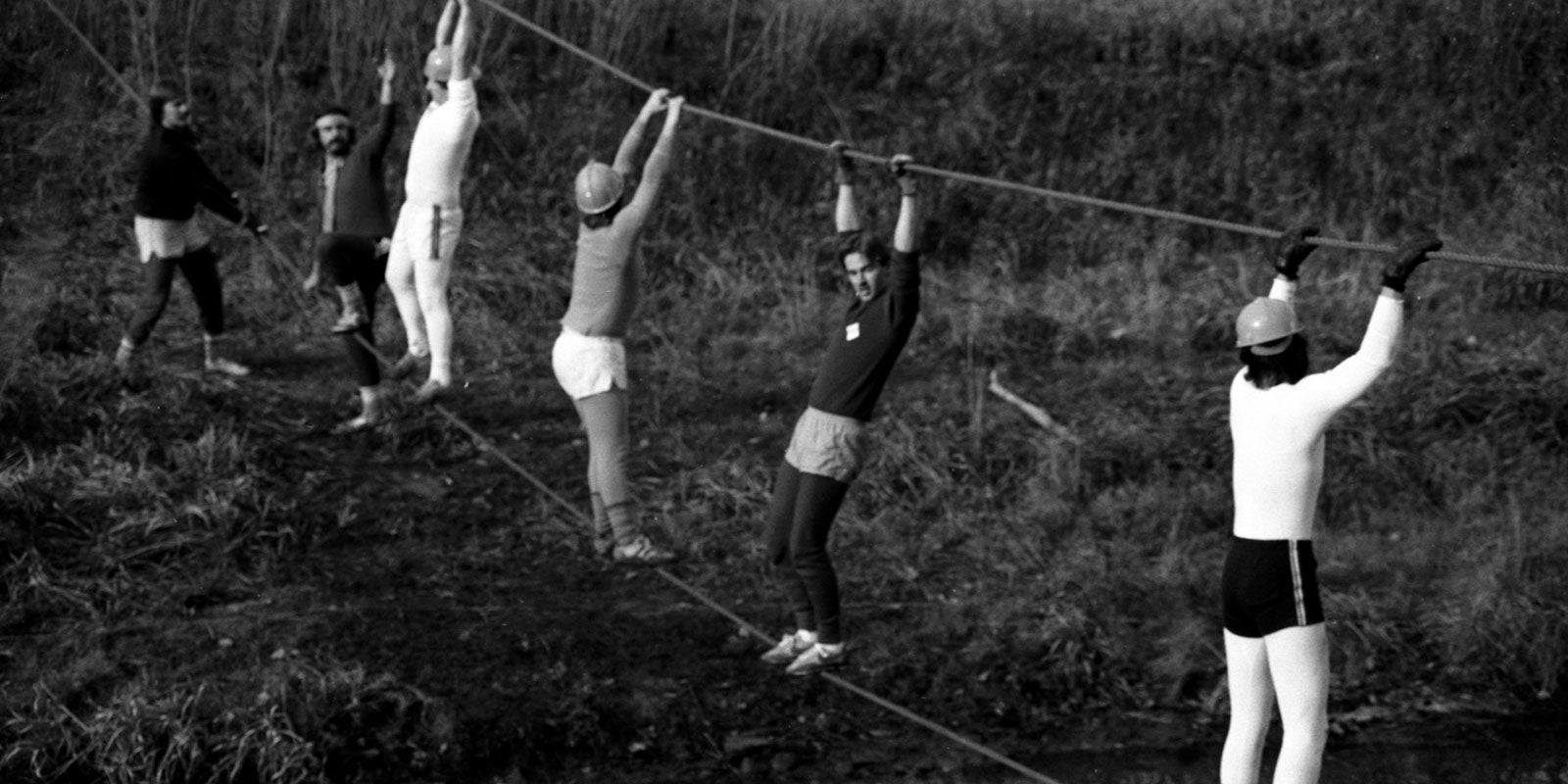
It will involve racing to the creek’s edge, pulling both ends of 200-foot sisal ropes up the banks, and tying them to nearby trees to hang above the water. One rope goes high for hands to grip, and one below for feet to shuffle along. That’s the “bridge.”
The competition will also involve shouting and laughing, as teams of 10 to 15 members complete 30 crossings, one while carrying a large bale of insulation (simulating a complicated construction-site rescue). It’s all about speed – the first industry and student teams to untie their ropes and return them neatly to the water’s edge get bragging rights and their names engraved on trophies, one for each group.
What the event is not about is calculations, estimations and other hard skills central to the program. In fact, “there’s no engineering,” says Lucas Khalaf (class of ’19), a project manager with Jen Col who competed as a student and continues with a team from the commercial construction company.
That’s fine; from the start, engineering has never been the point.
More than one kind of bridge
That’s confirmed by the Northern Torch, NAIT’s student-led yearbook that ran from 1964 through 1993.
“On September 27, 1975, Building Construction Technology [as the program was known] held a very successful bridge building contest, Building Construction winning of course,” reported the 1976 issue.
Medical X-ray and Medical Laboratory students also entered a team, and so did Civil Engineering Technology, which “ended up with some wet ones, but all in all it was a good entertaining day.”
That is, the idea was mostly to have fun. But, sometimes, fun is how things get done.
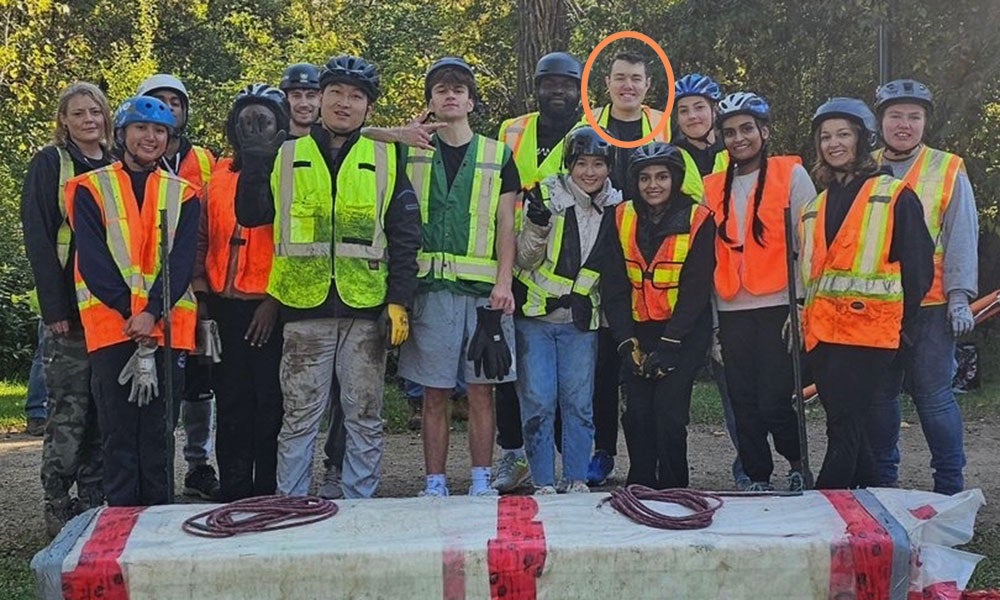
Second-year Construction student Riley Doyle (circled in photo above) captained a team in 2024 with that in mind. “We didn't do great, honestly, as first-years,” he says. The trade-off is that “people made some good connections that have lasted.”
The bridge building competition has always been about building more than one kind of bridge. Doyle’s first-year team, for example, comprised students from different cohorts, boosting collaboration opportunities for class projects. But it was also simply a way to make friends.
Khalaf would agree, noting that he recently attended the wedding of a friend made during competitions as a student. He also sees the potential for developing professional relationships.

“The other benefit is that students get exposed to industry in a very informal way,” he adds.
Known since 2022 as the Gary Stroich Bridge Building Competition in honour of a former instructor (see sidebar), the event has become students’ introduction to companies they aspire to work for, such as Jen-Col, PCL, Clark Builders, Ledcor and Fillmore Construction.
Engaged participants tend to be remembered at industry mixers the program later stages, says Khalaf. In fact, he credits the event with helping him overcome shyness and build relationships that ultimately led to his current role.
In the meantime, however, it’s a day of getting hands dirty, working to exhaustion, and creekside chaos and emotion. “We’re yelling and running,” says Khalaf. “You see the disappointment; you see the happiness and achievement.
“And everyone has pizza at the end, all together.”
The spirit remains the same
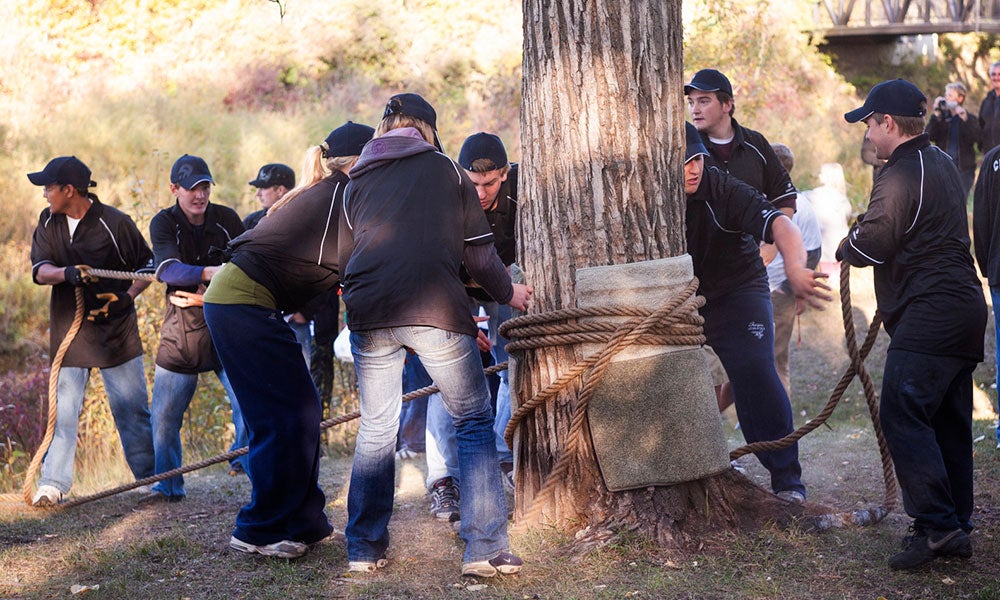
If anything has changed since that first event – besides the introduction of waivers and personal protective equipment – it’s recognition that the competition plays a role in fostering the soft skills students will use in their careers.
“It's really built around collaboration, coordination and management of a very small project in a finite period of time,” says Ken Williams, Construction Engineering Technology chair.
With one eye on his career, Doyle sees those as the keys to his success. With the other eye on the upcoming event, he sees them as the keys to redemption.
To improve their standing against industry teams, “proper communication is the main thing,” he says. “The second you stop talking, that's when stuff starts to go awry.”
But the creek can be cruel. Williams notes that it’s unusually high this year. Even Khalaf, despite helping lead Jen-Col to victory in 2024, sees no guarantees against ending up with a few “wet ones” among his group of veterans.
“I’m sure at some point, I'm going to get overconfident and humbled real quick,” he says.
In some ways, despite the passage of so many years, the event hasn’t changed at all. The spirit remains the same. And maybe the rivalries, too.
“I'm hoping we can beat Civil if they have a team,” says Doyle. Either way, he adds, “I'm just there to have fun.”
In remembrance of Gary Stroich

Alum Lucas Khalaf remembers the late Gary Stroich (Architectural Technology ’79), a Construction Engineering Technology instructor who started in 2000, as strict but dedicated. “We had a funny relationship,” he says, recalling how he would playfully ask questions or share comments he knew would raise Stroich’s ire.
(Stroich responded with a demerit system that would lead to Khalaf buying doughnuts for the entire class.)
But Khalaf also sincerely respected his teacher, who became a mentor upon graduation.
“He was a phenomenal human being – so caring about the industry. He pushed the program in the right direction.”
Instructor Ken Williams agrees. “Gary, quite honestly, was the heart and soul of the program. He was the tie that bound everything.”
Stroich was a champion of the bridge building competition, and also led capstone projects, where he insisted students be able to explain the “why” behind their proposals. “Gary had a certain way – a good way – of getting under students’ skin,” says Williams.
In the end, both he and Khalaf remember the instructor as a friend. Stroich passed away in March of 2021 at the age of 62. The bridge building competition was renamed for him the following year.
“We still miss him every day,” says Williams.
Northern Alberta Institute of Technology
Mailing Address:
11762 - 106 Street
Edmonton, AB, Canada, T5G 2R1
At NAIT, we honour and acknowledge that the land on which we learn, work and live is Treaty Six territory. We seek to learn from history and the lessons that have come before us, and to draw on the wisdom of the First Peoples in Canada. Only through learning can we move forward in truth and reconciliation, and to a better future together. Read more
About techlifetoday
Techlifetoday is the source for NAIT alumni and students to discover news about the polytechnic, and insights, advice and inspiration from the NAIT community to help them build successful careers and lead fulfilling lives.
