
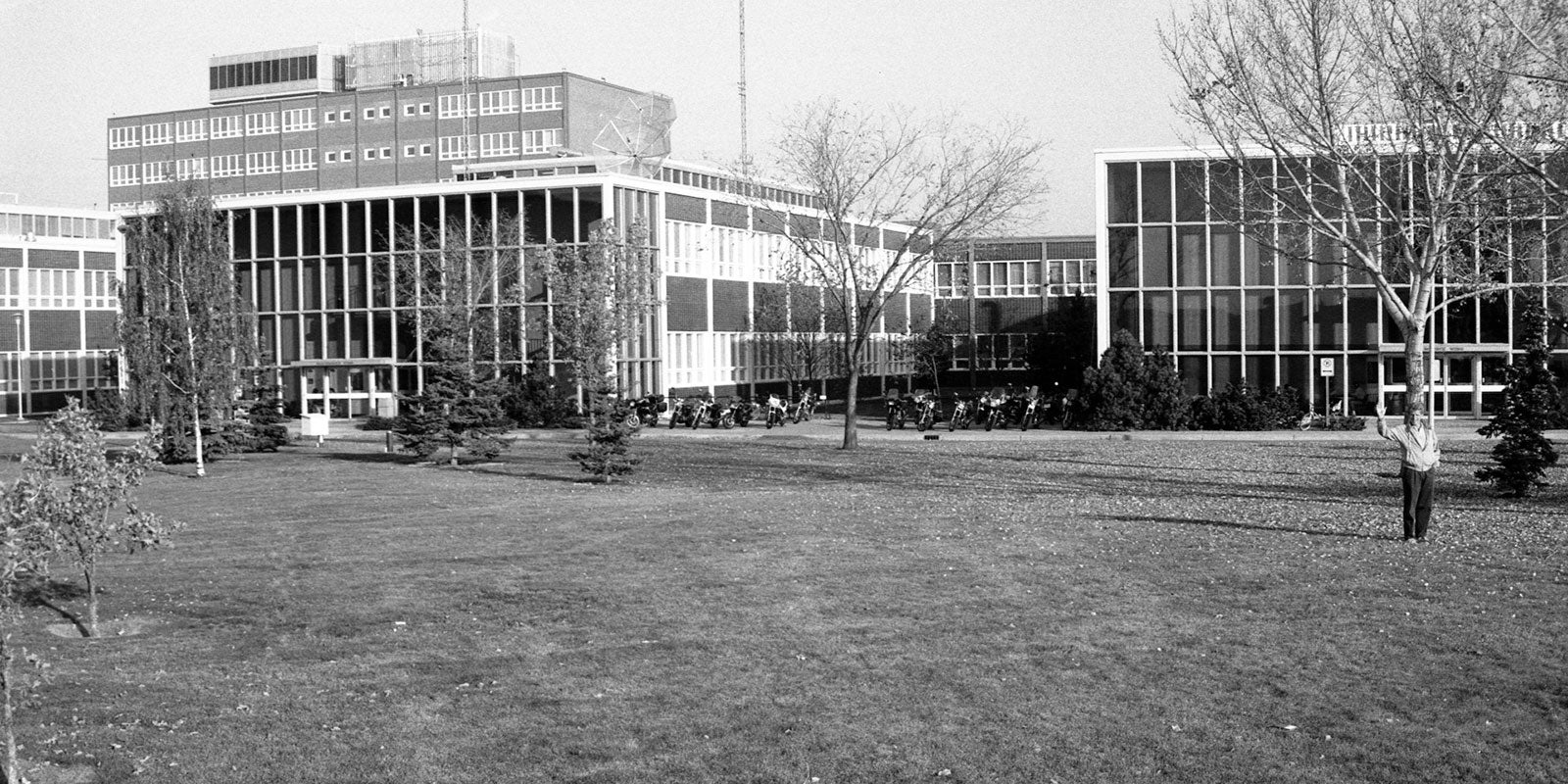
Finished in 1963, structure was a shining example of modernist architecture
“15 acres of floor area under one roof”
Few things are designed well enough to keep up the appearance of being modern throughout decades. NAIT’s original Main Campus may be among them.
In October, the local registered architects David Murray and Greg Whistance-Smith visited the polytechnic to share their insight in an Edmonton Design Week session entitled “NAIT Night – History & Boundaries in Design.”
Attended by an audience that included students, staff and alumni of NAIT’s Architectural Technology, Interior Design Technology and Landscape Architectural Technology programs, the talk shone a light on an otherwise unsung specimen of the city’s architectural heritage.
With construction overseen between 1961 and 1963 by what was then called Alberta Public Works, the brand-new campus was a glimmering example of modernist architecture. The style was championed and fostered in Europe, and marked by a stark departure from the bulky, ornate stonework of the age before it.
Made of concrete, brick, metal and glass, NAIT had the look of being focused on function. And it would help usher in a design future that would unfold for years in Edmonton, influencing the built environment by virtue of its own design and by what was taught in its classrooms.
Here are highlights from a discussion of a highpoint in northern Alberta’s architectural heritage.
Learn about programs offered by NAIT's School of Construction and Building Sciences
How modernism happened (short version)
“Architecture is always a blend of culture and technology,” said Whistance-Smith. In this case, it was also a physical reaction to the changing times (with a nod, Whistance-Smith added, to traditional, modular Japanese design and construction).
Following the rise of industry and the World Wars, “you had a culture of wanting to do things a new way.”
The elegant decoration, small windows and other features typical of previous architectural styles were not new ways. The question was, said Whistance-Smith, “Why aren’t our buildings matching the spirit of the age?” Modernist architecture, with its bright, smooth surfaces and clean, straight lines, was part of the response.
How NAIT became modern
“This was more advanced than the University of Alberta at the time,” said Murray, comparing NAIT to the much older campus south of the North Saskatchewan River, anchored mainly by ornate Edwardian structures.
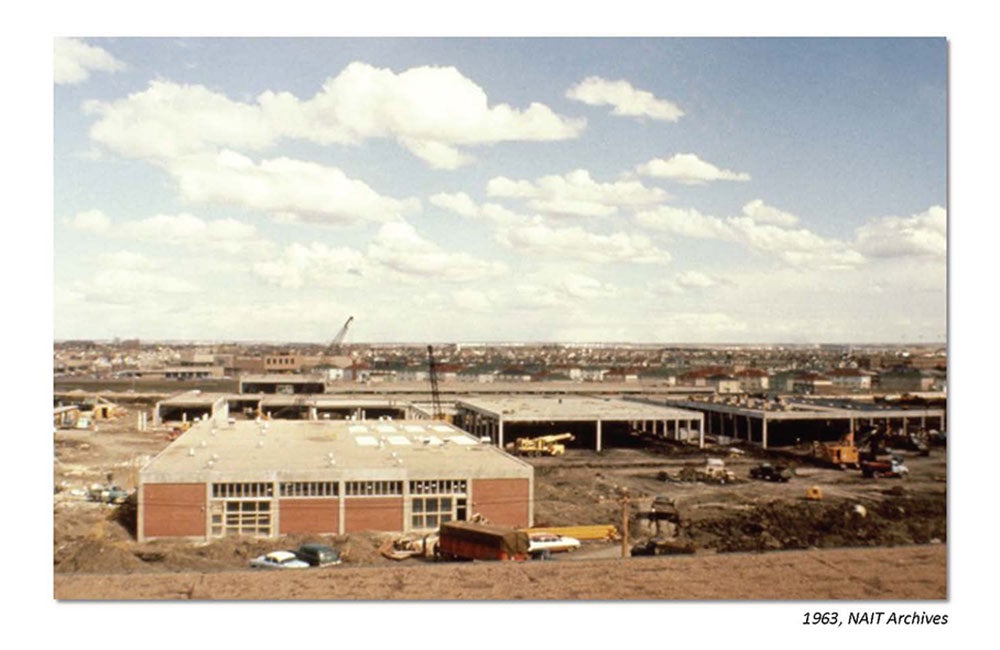
NAIT, however, had the benefit of being composed on what would eventually be a 21-acre blank slate, beside the city centre airport
“Where NAIT is now, there was a whole field of barracks set up for the American soldiers who came here as part of the war effort,” Murray noted.
The shape of campus was influenced mainly by two factors. One, said Murray, was the nearby Westwood Transit Garage, a successful use of precast concrete, or poured frames and forms that stood in for elements such as steel beams during post-war materials shortages. Used in repetition, they’d underpin the modular nature of the modern campus.
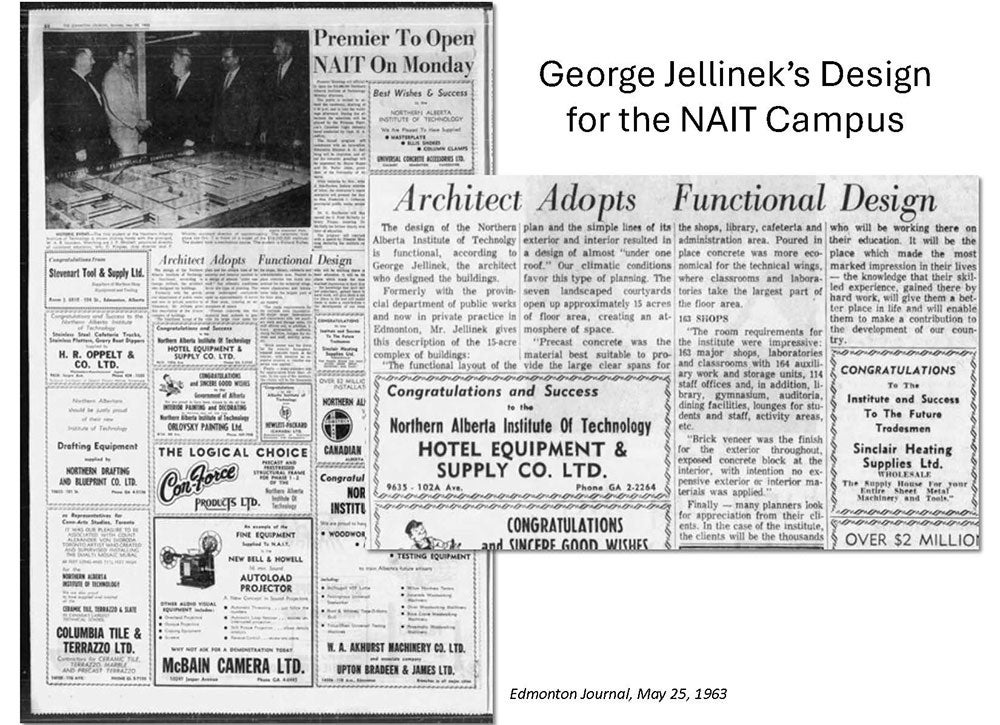
The other factor was the campus’s designer, George Jellinek, an Alberta Public Works employee from the late 1950s to the mid-1960s. Originally from Austria, Jellinek was influenced by the style in Europe, suggested Murray. His character – along with provincial government directives to keep things relatively simple – may also have played a role in his choices for NAIT campus.
Jellinek was “obviously a very modest guy,” said Murray. “He just talks about it being a functional design.”
Murray also pointed to the Illinois Institute of Technology, home to a collection of buildings by renowned modernist architect Ludwig Mies van der Rohe, as possible inspiration.
“My guess is that George thought this was a very beautiful movement and … wanted to bring it to the campus here.”
What makes NAIT modern
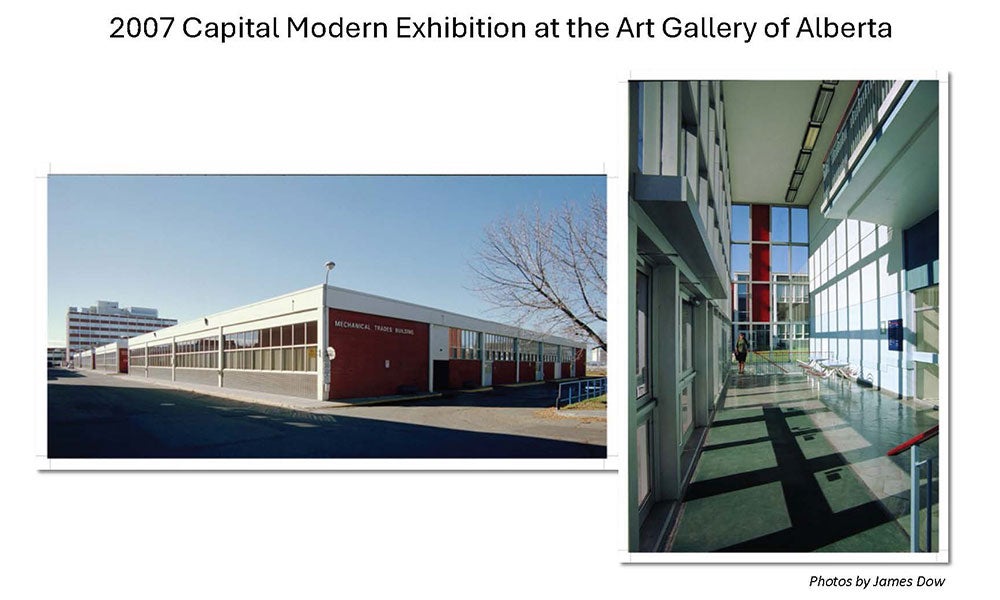
Among NAIT’s most modern features are its sightlines: stand at the end of one hallway and you can see it stretch uninterrupted for several hundred metres. In fact, as described in Capital Modern, a 2007 exhibit and book curated in part by Murray, the original campus “featured 15 acres of floor area under one roof.”
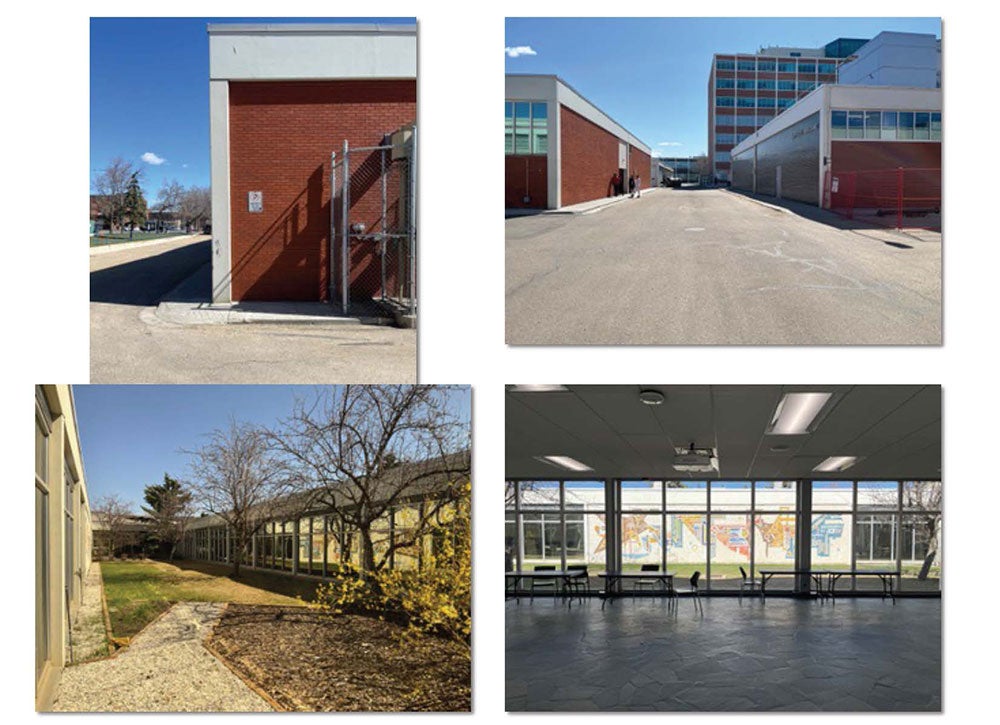
Whistance-Smith likened this layout to a grid, outlined by those precast columns and beams. “Once you have this three-dimensional grid, you can just instill it with panels, or not,” he said.
“It’s very light, it’s very airy, it’s intended to be flexible … and it’s very different from European masonry buildings where your best case scenario is a brick perimeter wall.”
But Jellinek also softened the edges of his design, Murray noted. At the heart of the campus, “you have these beautiful interior courtyards, which was a really nice thing to provide the students of a technology school.”
Today, they’re full of mature trees and shrubs, picnic tables and gazebos; one hosts a garden tended by the Culinary Arts program.
Maintaining modern
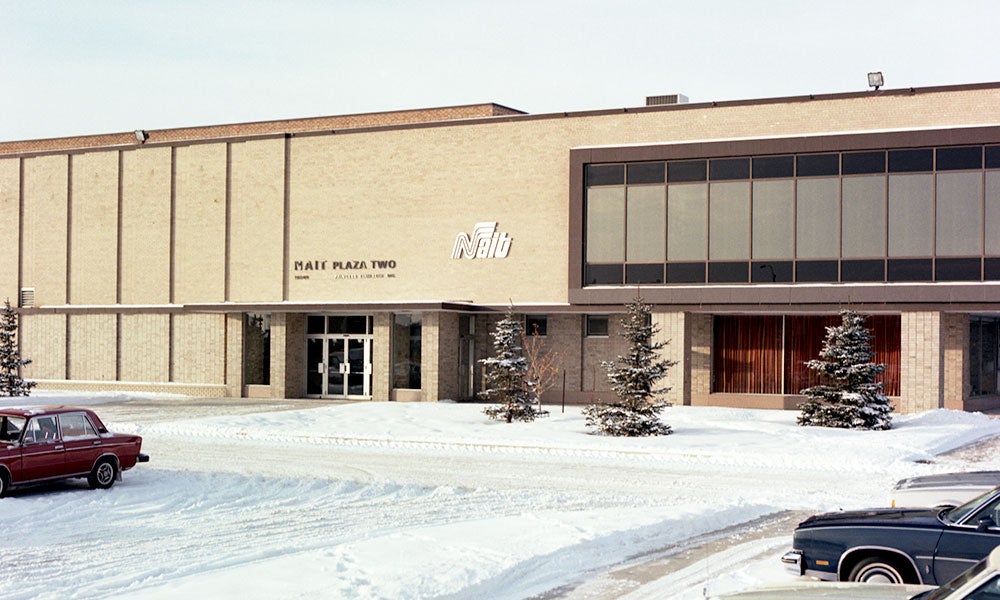
NAIT campus has nearly tripled its original footprint. It includes new buildings such as the Feltham Centre and the Productivity and Innovation Centre, as well as a parcel of the Blatchford lands (the former city centre airport) and the site of the Westwood garage, recently demolished to make way for the polytechnic’s Advanced Skills Centre, now in planning.
This November, the NAIT community began consultation on a new 30-year campus development plan. It will look at how the polytechnic uses its current facilities, as well as at their lifespan. That includes the original Main Campus, which Murray acknowledged will need upgrades for what he hopes is indefinite reuse and adaptation.

(The precedent has been set. NAIT’s Continuing Education and Industry Training Centre is a converted Simpsons-Sears store. It opened in September 1977 as classroom space for credit programs, with Architectural Technology students among the first occupants.)
In the meantime, however, the original campus stands as testament to having met the needs of the moment while acknowledging a fast-approaching future. As for George Jellinek, he would go on to start his own firm, then moved to Hawaii, where Murray noted that the architect’s history becomes unclear.
But in Edmonton, and perhaps most particularly through NAIT, the evidence of his impact remains. “He left his mark on the city,” said Murray.
Northern Alberta Institute of Technology
Mailing Address:
11762 - 106 Street
Edmonton, AB, Canada, T5G 2R1
At NAIT, we honour and acknowledge that the land on which we learn, work and live is Treaty Six territory. We seek to learn from history and the lessons that have come before us, and to draw on the wisdom of the First Peoples in Canada. Only through learning can we move forward in truth and reconciliation, and to a better future together. Read more
About techlifetoday
Techlifetoday is the source for NAIT alumni and students to discover news about the polytechnic, and insights, advice and inspiration from the NAIT community to help them build successful careers and lead fulfilling lives.
