
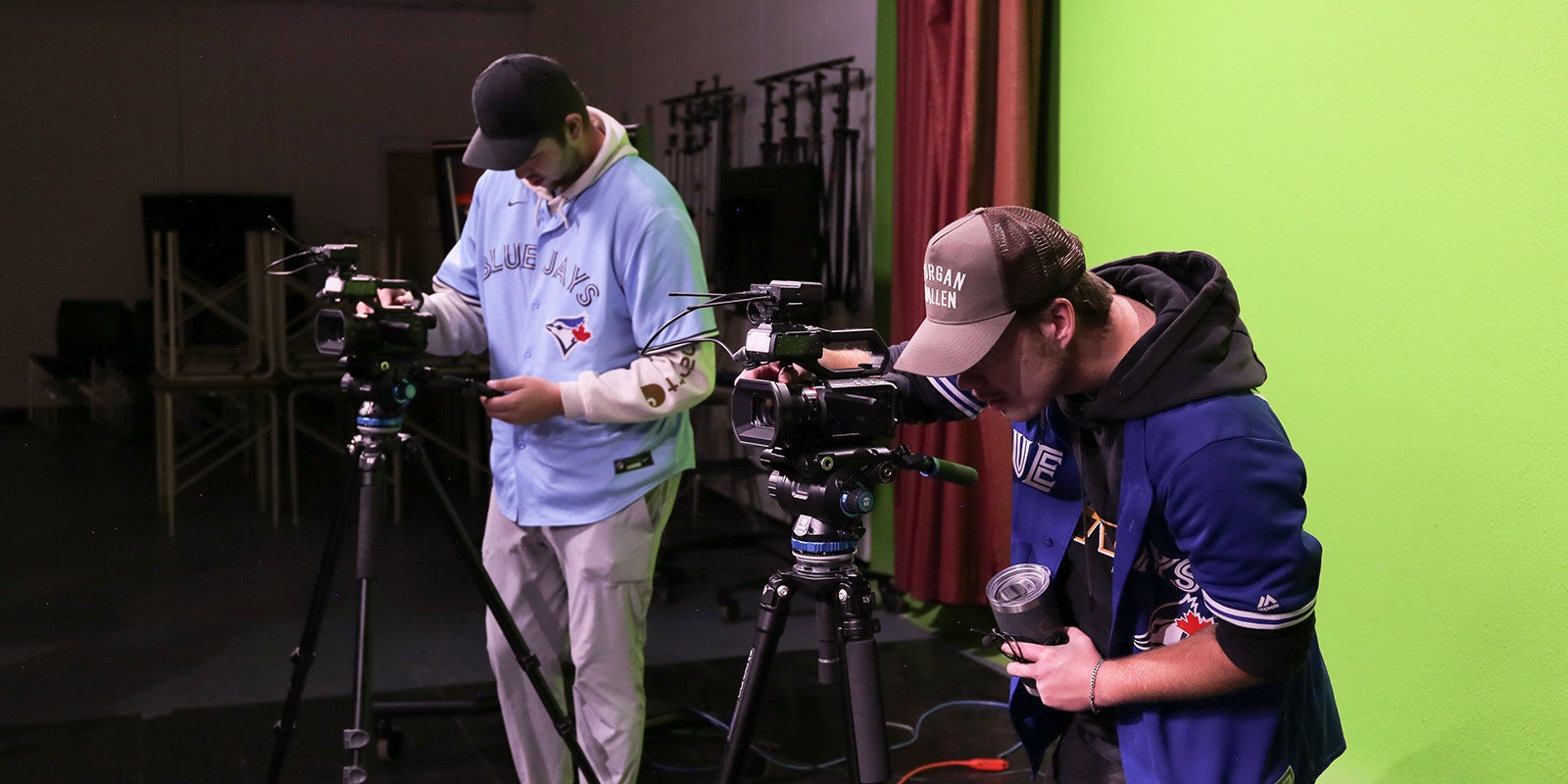
After 30 years, Radio and Television is now Media Communications and Production
Program recasts education for a content-driven industry
Abby Cunningham’s career may surprise some, given all she’s done since recently graduating.
Cunningham (Radio and Television – TV ’24) has been a videographer for the Edmonton Riverhawks, capturing homeruns and stolen bases at Re/Max Field. She’s pulled cable for handheld camera operators at Oilers games, threading 60-foot lines through the stands. She’s produced social media for the Western Hockey League (WHL), following as many as nine games at once.
Next, she’s taking a role as an onsite social media coordinator at a Banff ski hill.
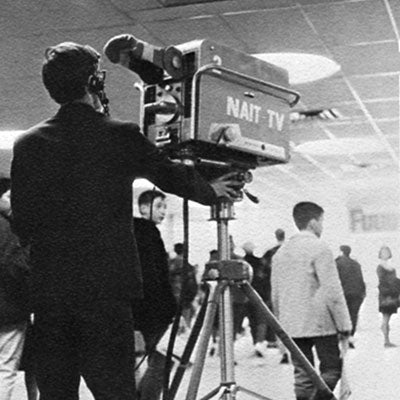
“I didn't realize that there were this many doors and different paths for me to go,” says Cunningham (pictured below).
And there will be more. Because of the relentless morphing of the media industry (and the fact that she’s only 22), Cunningham has not yet done it all.
But the one thing she feels she hasn’t really done – and may never do – is broadcasting in the traditional sense of television or radio.
Cunningham doesn’t see her work in terms of linear transmissions from station to consumer. Rather, she operates as part of a complex network of media and audiences, with messages – content – travelling both ways.
Otherwise, the concept of broadcasting “doesn't really fit my job,” she says.
Her past instructors can see it that way, too. Content is king of all it surveys, which is a vast and varied landscape. There's still that bedrock of radio and television, but now also elements such online content, social posts and more.
To acknowledge that evolution, the program name of “Radio and Television” was retired this summer after three decades. In its place, but still rooted in that bedrock, Media Communications and Production now represents a program designed to sustain the aspirations of the likes of Cunningham, and a new generation of creators.
Learn more about Media and Communications Production – Television and Media Production
The skill at the heart of it all
In a recent CBC Radio interview, veteran instructor Patrick Galenza described the change as a lengthy, considered process. It began with a curriculum review about five years ago, with one eye on the direction of the industry and the other on the enduring purpose of a program established in 1967, making it one of NAIT’s oldest.
(It was Radio and Television Arts originally, a name that would appear on graduation parchments until 1996, when the two media streams replaced “Arts.”)
“We still teach the traditional radio and television but we’ve added so many other parts,” said Galenza.
For example, new courses include “Mobile Journalism,” which covers reporting and story gathering on the go, and a series on “Online Media,” such as social platforms. There was a time in recent collective memory when tools for both didn’t exist.
Learn more about Media and Communications Production – Radio and Media Production
“The industry has changed for sure but the opportunities still seem to be there,” said Galenza.
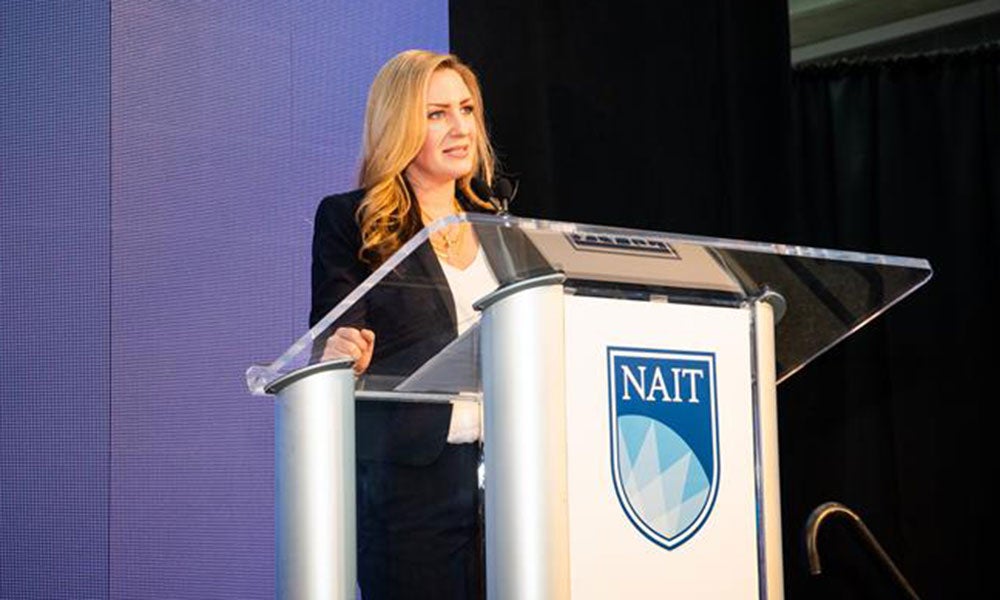
Erin Chalmers (Radio and Television – TV ’02, pictured below) notes audiences’ steady migration to the internet. “They're not watching traditional television the way that they used to,” says Chalmers, a Global News Morning co-anchor and NAIT volunteer program adviser who contributed to discussions around the name change.
“Markets have had to adapt. Newsrooms have had to adapt,” she says. “You're no longer just relying on people having a cable package and turning on your channel.”
Parallels remain, however, between her and Cunningham’s early days. More than 20 years ago, Chalmers cut teeth at community stations throughout the Prairies. Much like Cunningham has the skills necessary for creating a variety of digital content, Chalmers left NAIT with what she needed to make broadcasting work with small teams.
Technical abilities were essential. But at the heart of Chalmer’s efforts was understanding how to tell a compelling, honest story – an ability still in demand, regardless of media format, and one that remains central to the program at NAIT.
Stepping stones to a dream job

“It's important that people learn the skills needed to be a proper journalist,” says Chalmers.
She believes that applies to content without exception. Cunningham would agree, thinking of her social media graphics for WHL final scores and top performers.
“They wanted a pretty quick turnaround with those posts, but they always wanted quality over speed,” she says of her supervisors. On rare occasions when Cunningham moved too fast, posts were removed, revised and replaced.
She understood. “It [has] to be well done because you're representing a whole league.”
Cunningham wonders if a two-year diploma by any name is too short to cover the breadth of the industry as she’s seen it. (She learned the subtle differences between camera lenses at the ballpark, for example.) No matter what she’s done, though, “I got all the stepping stones I needed from NAIT.”
She isn’t sure where those will lead her. Currently, “I'm just seeing where the road takes me and figuring it out as I go along,” Cunningham says.
She looks forward to eventually settling into a steady, full-time role, but wonders if a long-term position like Chalmers has had with Global is likely in today's market. Nevertheless, Cunningham is convinced her future holds the excitement and satisfaction of continuing in sports media, one way or another. She dreams of landing a job making branded content for Red Bull, highlighting the beverage company’s extreme athletic events.
Why not? What Cunningham learned at NAIT as its media programs had changed in nearly all but name has given her confidence in her abilities. The industry will continue to evolve, and she feels she knows how to adapt as it does.
“It’s still storytelling,” she says.
Northern Alberta Institute of Technology
Mailing Address:
11762 - 106 Street
Edmonton, AB, Canada, T5G 2R1
At NAIT, we honour and acknowledge that the land on which we learn, work and live is Treaty Six territory. We seek to learn from history and the lessons that have come before us, and to draw on the wisdom of the First Peoples in Canada. Only through learning can we move forward in truth and reconciliation, and to a better future together. Read more
About techlifetoday
Techlifetoday is the source for NAIT alumni and students to discover news about the polytechnic, and insights, advice and inspiration from the NAIT community to help them build successful careers and lead fulfilling lives.
