
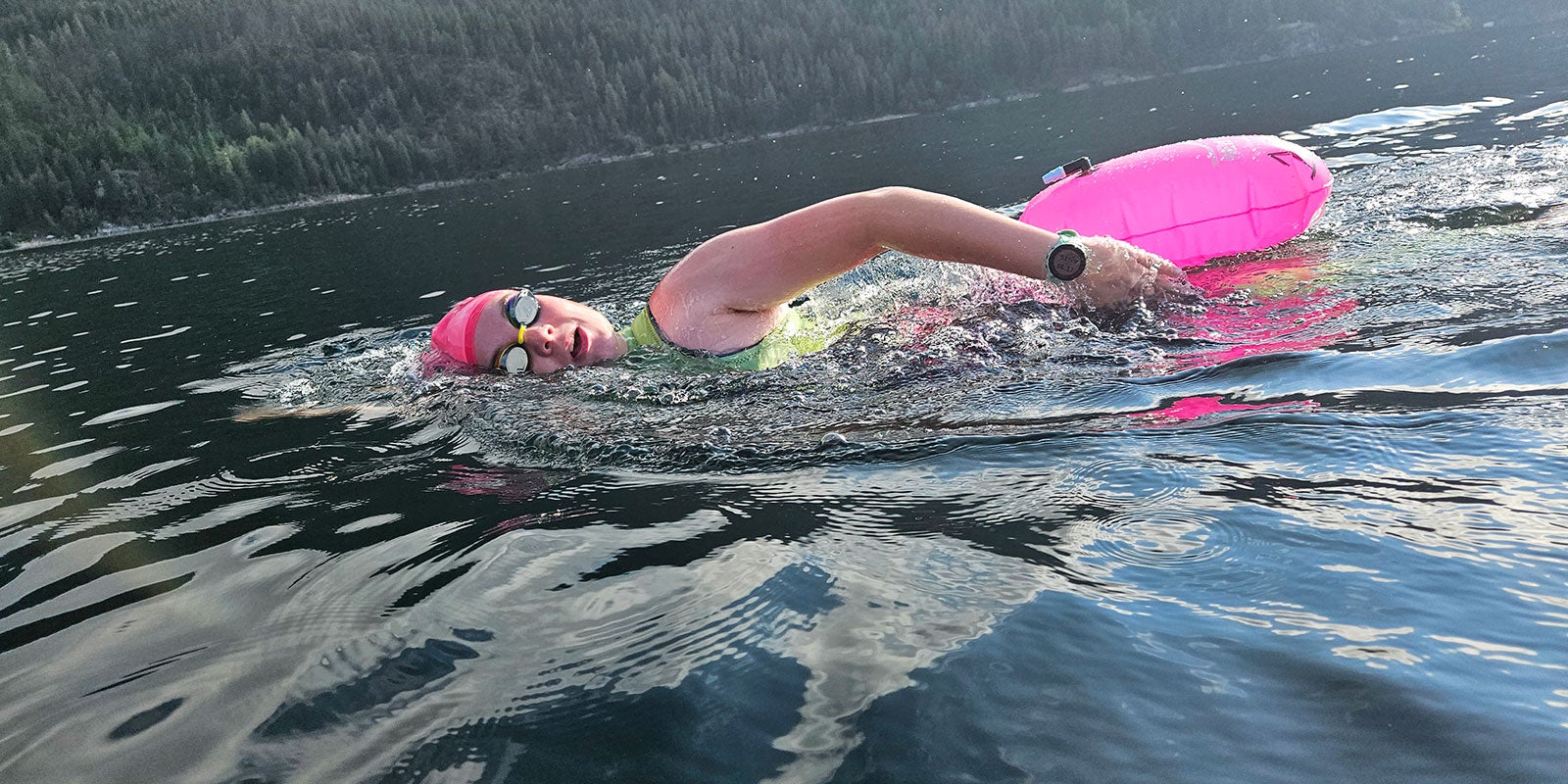
Robyn Coleman raising awareness and research funds as first woman to attempt record
“It was really hard to trust in my body again”
For a time, Personal Fitness Trainer student Robyn Coleman was afraid to work out. She was a seasoned swimmer but she knew that if she pushed too hard it could induce a headache. Getting dehydrated could, too. And a headache was the thing that changed her life.
In 2018, when Coleman was 12 years old, she suddenly lost her vision while reading. It returned minutes later, only to be accompanied by a headache so severe she collapsed, the left side of her body paralyzed.
Coleman had suffered a rare migrainous infarction. “The best way to describe it is as a freak incident where I had a super bad migraine and it caused a clot and that caused a stroke,” she says.
But the doctor at the hospital where she lived in eastern Alberta didn’t test for that, instead sending Coleman and her parents home with a recommendation of rest and ibuprofen.
It would be a month before she’d get the MRI that would explain what happened and allow her to begin a slow recovery enabled by a personal trainer and her own determination.
Today, that determination has led to an ambitious goal. On June 16, Coleman will begin a world record attempt at swimming British Columbia’s Okanagan Lake. It’s a distance of 106 kilometres that she hopes will raise funds for the Heart and Stroke Foundation of Canada, as well as the awareness needed to ensure that others get the help they need quickly.
Rebuilding trust
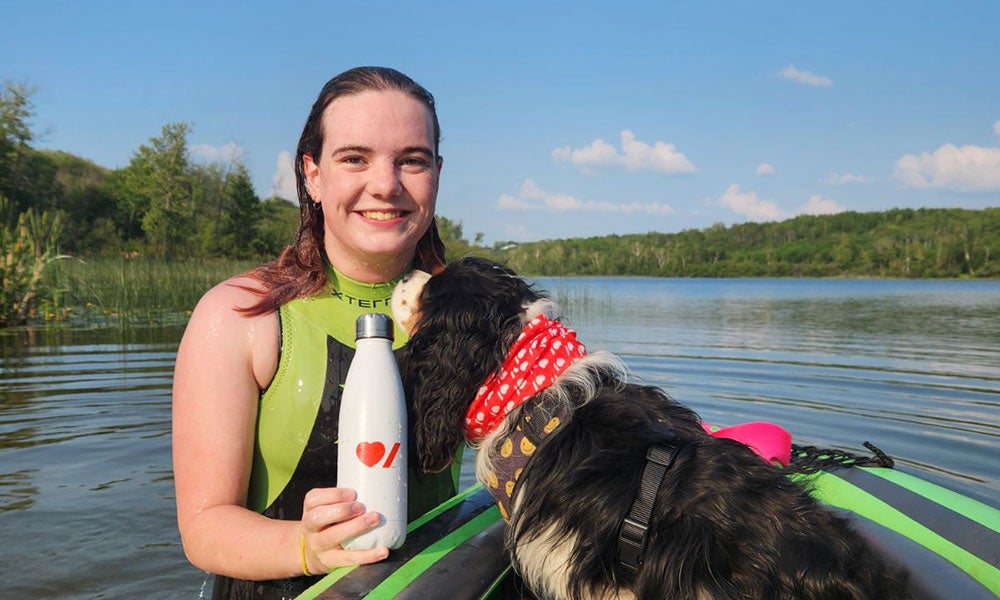
Coleman had grown up as a swimmer competing at the near-national level. “But after my stroke, a lot of technique and strength was lost,” she says.
Following her brain injury, she had trouble controlling her mouth, making speaking and eating difficult. It had further impacts on her mobility. “Fun fact,” Coleman says, “I used to actually be ambidextrous but now I'm only right-handed.”
To help with her recovery, her parents hired a personal trainer based in Edmonton. At first she met with him just once or twice a month, her parents driving halfway across Alberta for the sessions.
“It was really hard to trust in my body again,” says Coleman. “The personal training helped with that.”
Together, they worked on not only technique, but getting over “mental blocks,” such as that fear of headaches. Slowly, Coleman regained confidence. She even returned to competitive swimming, her mother moving with her to Edmonton to support her ambitions.
That progress can also be attributed to Coleman’s character. Personal Fitness Trainer instructor Craig Wourms (class of ’04) sees the swimmer as having the drive of a perfectionist. “She has certain standards,” he says. “She wants to meet them.”
But Wourms also believes Coleman also has the resiliency to do so, coupled with a deeply rooted motivation. “There's a … drive of, ‘I lost something but I'm not going to let it stop me.’”
In the end, Coleman’s return to swimming was likely inevitable. Wourms believes it gives her something nothing else can. He’s seen how much she enjoys coaching other swimmers and the community of her classmates but he also knows how much Coleman cherishes time to herself.
“She finds solitude when she's in the water,” says Wourms. “It's her happy place.”
Focused on moving forward
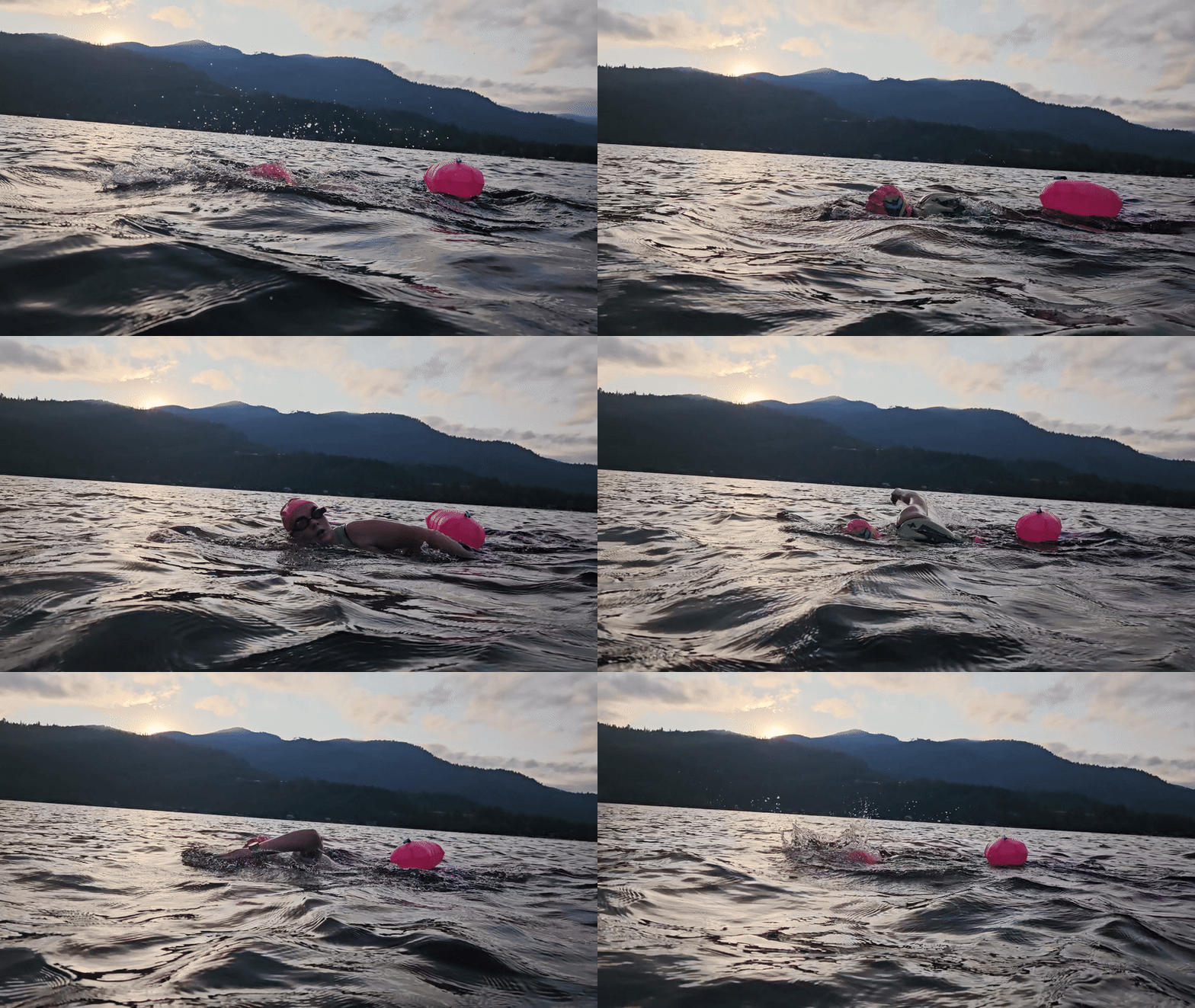
When Coleman turned 17 (she’s 19 now), she was aging out of the swimming circuit and wondering what to do next. That’s when she noticed that a male swimmer was preparing to swim the length of Okanagan Lake, a snakelike body of water stretching from Vernon in the north to Penticton in the south. He aimed to break the world record of completing the feat in just under 41 hours.
Why couldn’t Coleman set the record for being the first woman to swim the lake?
“I told my parents and we talked a lot about it,” she says. “And I decided that that was something I really wanted to do.”
Coleman aims to complete the swim in under 48 hours. Likely, she won't exit the water until the south shore but she’ll be accompanied by a support crew.
Another of her goals has already been reached. “Robyn's Marathon Strokes For Stroke” campaign set out to raise $100 for each kilometre, or $10,600, for the Heart and Stroke Foundation of Canada.
As of late-May, she’d raised more than $13,000, which she hopes will help fund “the next big breakthrough” in stroke and heart disease research.
Once the swim is done, Coleman wants to continue to have an impact on people’s health and well-being. She’ll graduate in 2026 from the program she was inspired to pursue because of the progress she made with her own trainer. Though she knows her life may have been different had she initially received proper care, she doesn’t dwell on it.
Instead, she’s focused on moving forward.
“That’s the side of things I want to be on,” says Coleman. “Recovery [and] helping people.”
Northern Alberta Institute of Technology
Mailing Address:
11762 - 106 Street
Edmonton, AB, Canada, T5G 2R1
At NAIT, we honour and acknowledge that the land on which we learn, work and live is Treaty Six territory. We seek to learn from history and the lessons that have come before us, and to draw on the wisdom of the First Peoples in Canada. Only through learning can we move forward in truth and reconciliation, and to a better future together. Read more
About techlifetoday
Techlifetoday is the source for NAIT alumni and students to discover news about the polytechnic, and insights, advice and inspiration from the NAIT community to help them build successful careers and lead fulfilling lives.
