

Kevin Wang pursues happiness through education in electronics
“He is no longer a student. He is my peer”
As much as he’d tried to prepare, Xinkai Wang (Electronics Engineering Technology ’25) admits his first semester at NAIT was challenging. In his mid-30s, the native Mandarin speaker struggled at first to learn English. In fact, Wang says, “it was a nightmare sometimes.”
But, as an international student from China and now a NAIT grad, he regrets none of it.
In August 2023, Wang arrived in Edmonton to study electronics. He’d come from Beijing, where he’d worked as a sales manager. He was ready for a career change, feeling little attachment to the work, drawing greater satisfaction from repairing a broken TV or washing machine.
But Wang was also ready for a much bigger change.
During the COVID-19 lockdowns in China, known to have been among the world’s most restrictive, Wang imagined the possibility of a different, freer future – not only for himself, but for his wife and young son. So, while he worked during the day, he studied English until late at night.
With the help of an immigration agent in Edmonton, Wang soon set his sights on NAIT, with plans for his family to follow once he was settled.
Those plans kept him motivated and, coupled with his own determination, prevented him from giving up. And he wasn’t alone. Thanks to help from instructors and other NAIT staff, nightmares of more than one kind are behind him. Today, Wang has within his reach a goal that was once just a dream.
“I want to live here,” he says of Edmonton. “I want to stay here.”
“You could tell he wanted to try”
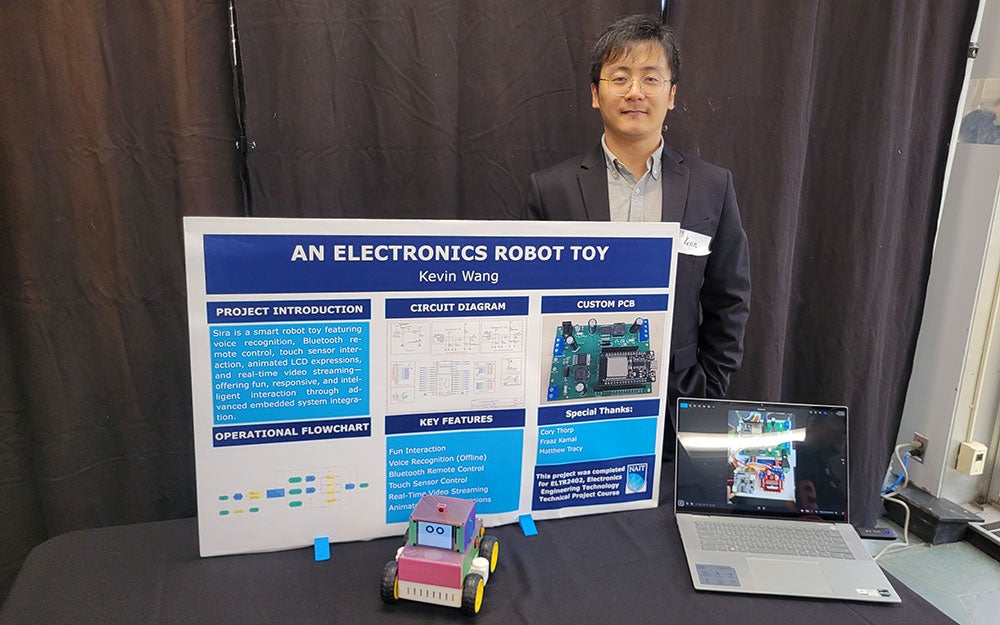
Instructor Cory Thorp (Electronics Engineering Technology ’16) recalls Wang’s early days in class.
“He would put my instructions into a translator app to try to help himself get through,” says Thorp.
Recognizing that the program – a mix of electrical principles, myriad components, programming and more – was hard enough for those proficient in English, Wang’s instructors exercised patience, if not compassion.
“You could tell he wanted to try,” says Thorp. “He put in consistent effort. He’s a smart guy.”
Wang’s intelligence went beyond technology, in that he was smart enough to seek out help he knew he needed. When stress started to mount, his anxiety becoming visceral, Wang sought support from the NAIT counsellors he learned about at student orientation. He began visiting weekly.
In addition to sharing advice on coping with stress, staff recommended that Wang augment his English studies by watching TV and reading books. The characters of Corner Gas joined the ranks of Wang’s teachers, as did The Little Prince, the 1943 novella by Antoine de Saint-Exupéry.
“I enjoyed it,” says Wang. “I read it every day in my first semester.”
Halfway through that semester, he felt more at ease with English, and able to focus more on excelling in his program.
Even in class, that focus remained largely connected to his family, who joined Wang in Edmonton in July 2024. When it came time to choose an idea for the technical project course that would close out his program, Wang proposed what would become a wheeled robot, built from scratch and operated by voice, touch and remote control.
That is, he asked Thorp if he could make a toy, and Thorp agreed.
“I chose that because I love my son very much,” says Wang. “I wanted to make him a gift.”
From student to peer
Both Wang and Thorp point out that Wang could have made virtually any kind of programmable electronics (at least, within the 15-week course).
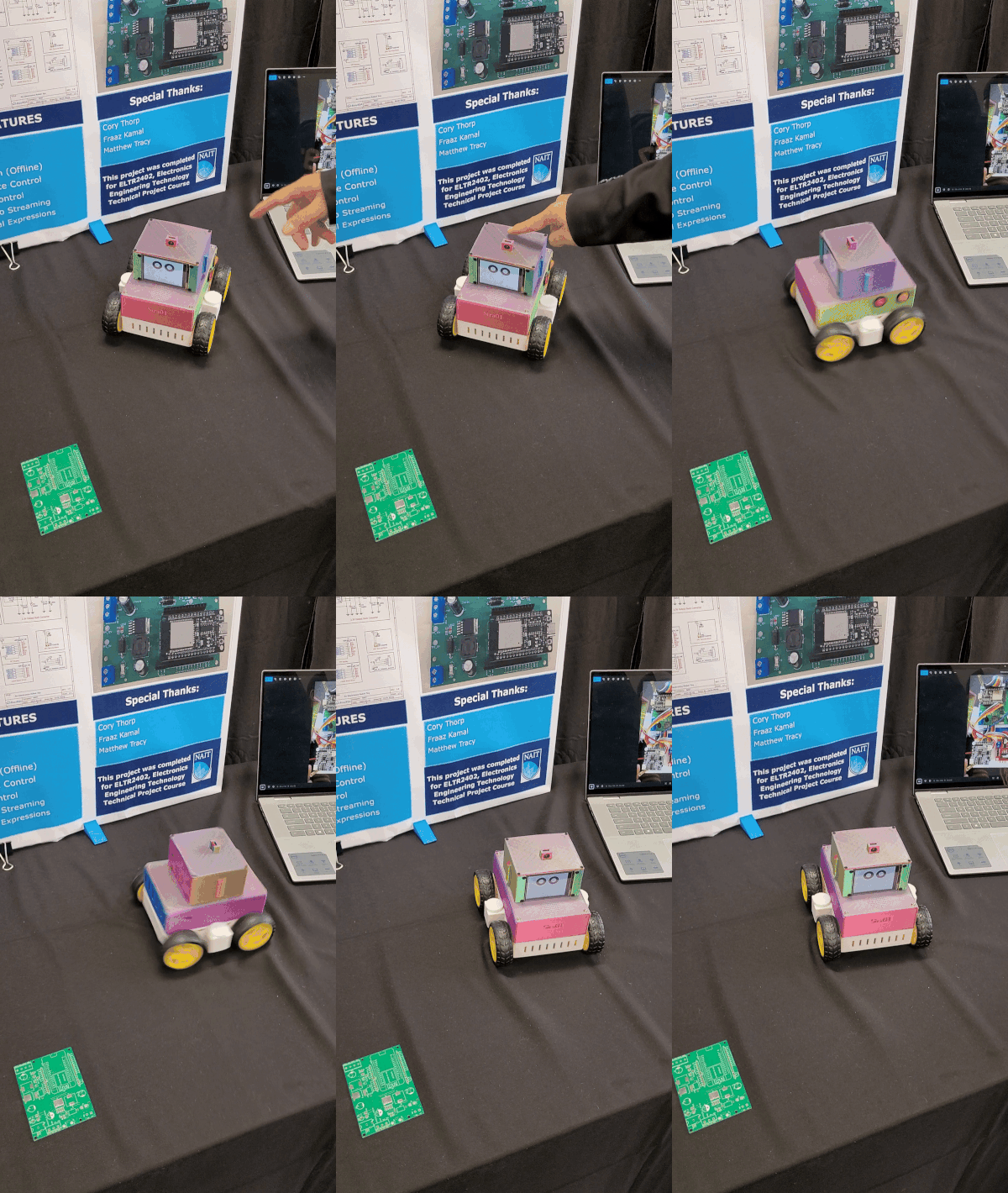
The skills Thorp and fellow instructors teach have varied applications. Projects by classmates included the likes of an automatic grass-seed spreader, sumo-wrestling robots, and a portable 3D printer, to name a few.
“We are a generalist program,” says Thorp.
That’s reflected in the number of career opportunities. Employers of program grads are “all over,” says Thorp.
Alberta Liquor Gaming and Cannabis, for example, need techs to keep slot machines spinning; Nav Canada needs them to maintain devices for air traffic control; research facilities need them to service lab equipment.
Landing such a job is Wang’s next priority, along with working toward permanent residency.
He’s feeling a mix of optimism and concern, knowing that an economy in the midst of a trade war can be a challenging environment for any job seeker.
But he also feels that isn’t the only environment that matters right now. Edmonton has become home for the family.
“We really enjoy … the parks, the river,” says Wang. He appreciates the sense of community he has already experienced in Canada, too. “I can feel it,” he says. “I like people here.”
Thorp would say Wang has the skills he needs to make a permanent place for himself in that community. “He is no longer a student,” says the instructor. “He is my peer.”
Thorp gave Wang an A+ for his robot project. Wang’s proud of that, just as he’s proud of all the learning, in and out of the classroom, that went into achieving that mark.
Just as importantly, he’s proud of what he’s done for his son. Since giving him the toy, Wang has watched the boy show it off and enjoy it with a friend, the two of them laughing together as they command it into motion.
“I felt so satisfied with that,” says Wang. “I felt so happy.”
Northern Alberta Institute of Technology
Mailing Address:
11762 - 106 Street
Edmonton, AB, Canada, T5G 2R1
At NAIT, we honour and acknowledge that the land on which we learn, work and live is Treaty Six territory. We seek to learn from history and the lessons that have come before us, and to draw on the wisdom of the First Peoples in Canada. Only through learning can we move forward in truth and reconciliation, and to a better future together. Read more
About techlifetoday
Techlifetoday is the source for NAIT alumni and students to discover news about the polytechnic, and insights, advice and inspiration from the NAIT community to help them build successful careers and lead fulfilling lives.
