
NAIT program guides aspiring apprentices through community-building projects
Community-led initiative prepares students for apprenticeship opportunities
Kalus Papin was working a shift when he saw the sign that pointed to a better future than he’d expected for himself.
That sign was, in fact, a poster on a wall. He noticed it while making the rounds as a surveillance staffer at the River Cree Resort and Casino. It called for applicants for an introductory pre-trades program delivered by NAIT to guide students through the construction of a building in the community, Enoch Cree Nation. That’s where Papin grew up.
He liked his job but had other ambitions. “I was always interested in doing some form of carpentry or woodworking,” says Papin, now 23. “So I thought I’d give it a shot.”

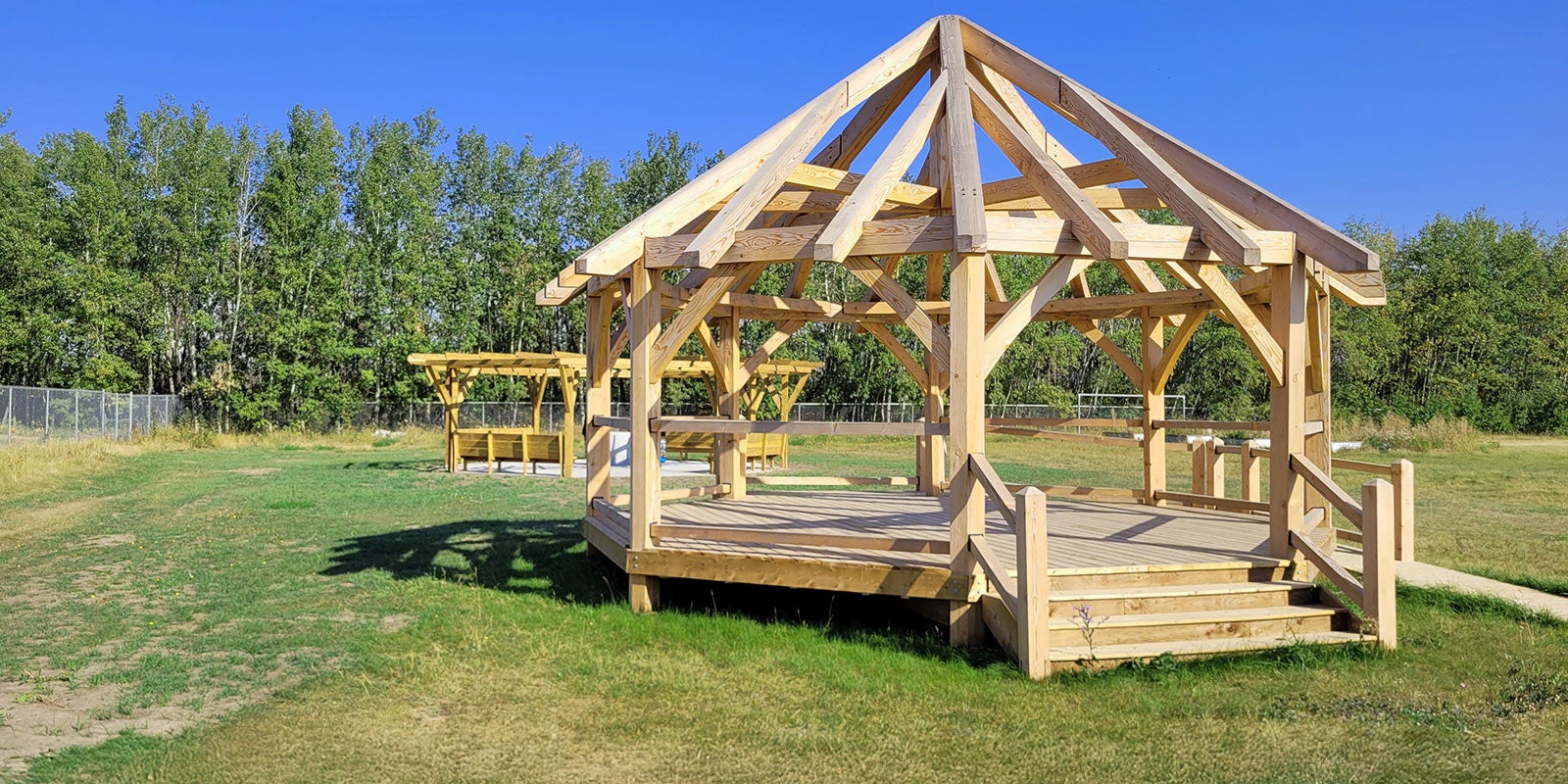
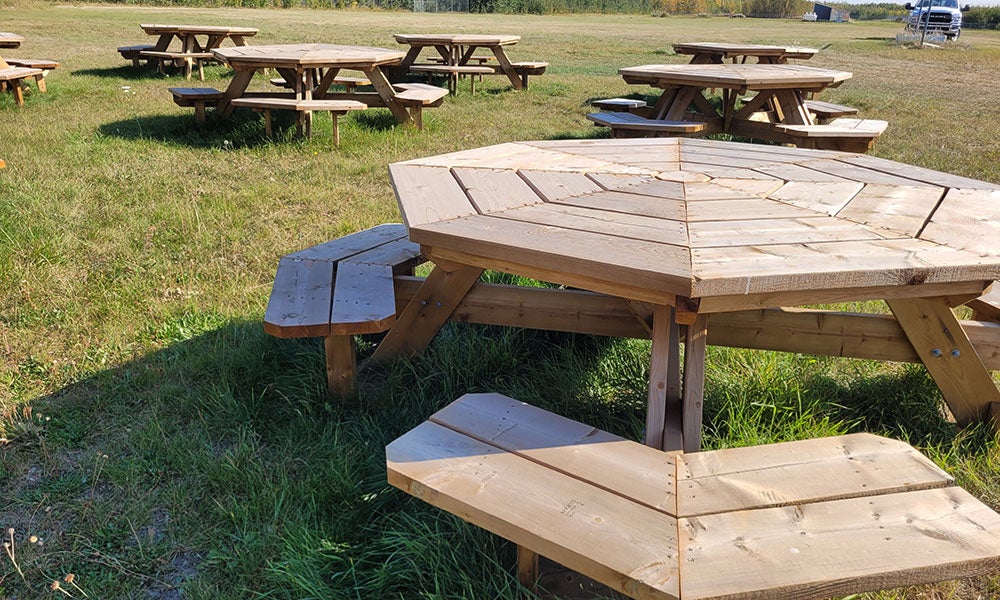
Today, that attitude has helped to transform the yard behind the Mamowicitowin Building, a hub for supports and initiatives run by the community. A new collection of octagonal picnic tables, built by Papin and seven other students, flanks one side of a 25-foot-tall gazebo they later crafted from heavy timbers of Douglas fir.
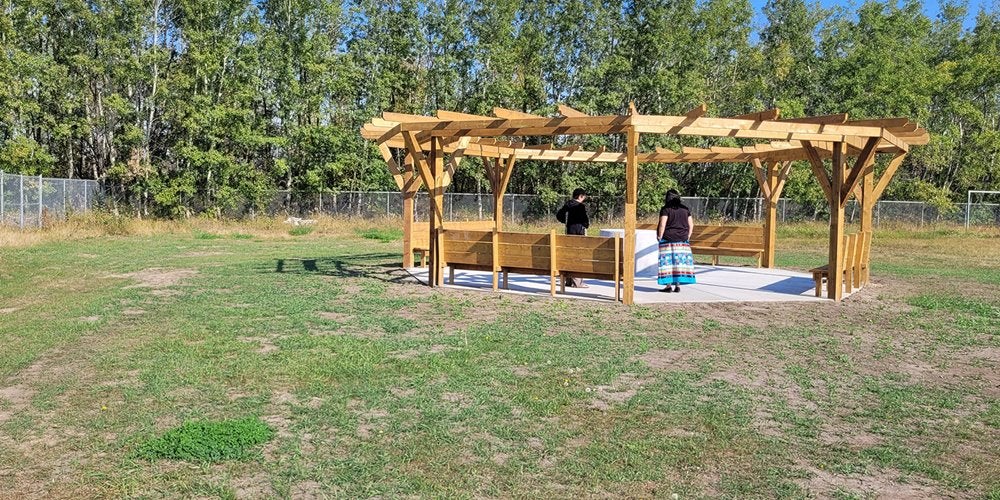
Nearby is a healing garden, built by a class that followed Papin’s. It’s octagonal, too, and 30 feet across. It features four long benches that align with the cardinal directions and encircle a central concrete altar, tall and broad to support a large metal smudge bowl.
Before the work, says Papin, “I was completely green.” But by building tables and the gazebo, he effectively built a doorway. After the projects were complete, Papin found his way into an apprenticeship with a company working at Enoch. He builds concrete forms for new water treatment facilities being built for the Nation.
“That’s a whole other new thing I've been introduced to,” he says. “Life just keeps going up.”
An unexpected opportunity
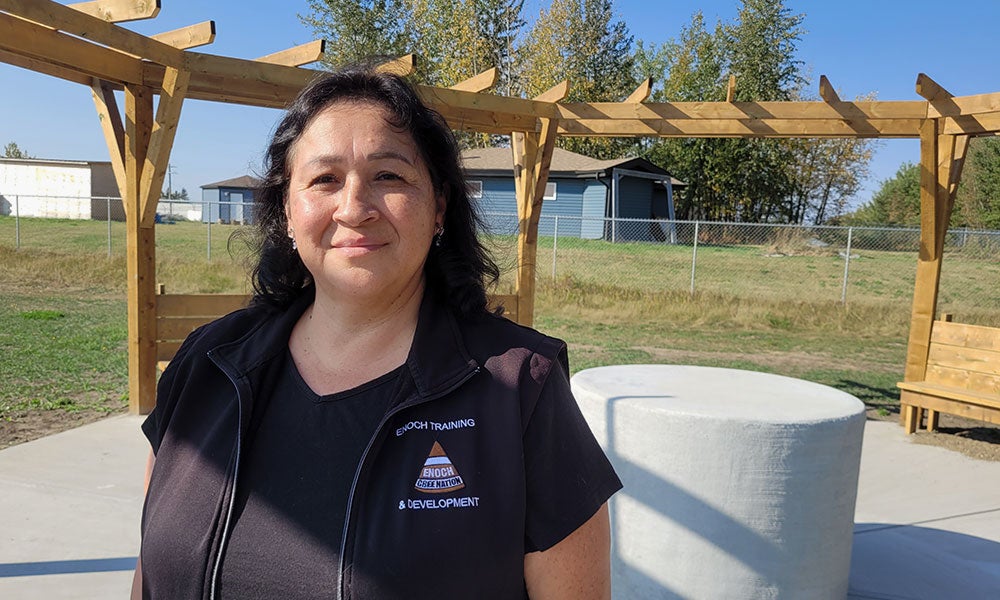
Joanne Sharphead, manager of training and development at Enoch, had been dreaming about these projects since before the pandemic – which postponed them but also made them all the more necessary.
She saw the tables and gazebo as a unique but practical gathering place for meetings, celebrations and learning for Mamowicitowin, where she works, and where indoor space is limited.
As for the garden structure: “It’s a place of healing, of prayer, of teaching,” says Sharphead. “That’s something that we really need for our Nation – to have that safe space where we can do that comfortably.”
Ultimately, the postponement presented an opportunity. In summer 2024, another department at Enoch was finishing a project with NAIT’s Indigenous Partnerships and Engagement (IPE) team and local students to build tiny homes for the community. Sharphead wondered if the model could be applied to her projects, adding to them the benefit of hands-on education.
“The answer was obviously, ‘Yes, we definitely can,’” says Chase Gallagher, an IPE community engagement specialist who works with Indigenous communities across Alberta on customized education and training. In 2025, the polytechnic worked with more than 70 First Nations, Métis and Inuit organizations.
“These are probably the largest custom projects we've ever done,” Gallagher notes. In cooperation with the community, NAIT staff interviewed between 50 and 60 applicants for Sharphead’s projects. It created customized classroom curriculum (delivered by Trevor Aboussafy, Carpenter ’22), then guided students through the construction process.
Work on all the projects was completed in August 2025, followed by graduation events for participants.
“This meant so much to me,” says Sharphead. “It’s been on the table for a long time and to finally see it, I can’t thank everyone enough for their hard work. They went above and beyond what we asked them to do.”
Learn more about how NAIT partners with Indigenous communities
Returning a favour
Regarding his own contribution, Papin doesn’t see it that way.
“I always wanted to give back to my community,” he says. “They’ve really helped me a lot, from a kid to adulthood. This is just a small part of me returning the favour.”
The project was the chance to get ahead that he’d been waiting for, Papin adds. “To finally get that opportunity, I was extremely appreciative.”
By the end of 2025, Papin had already logged nearly enough hours to qualify for his first theory exam needed to complete the first period of his Carpenter apprenticeship. But he’s already looking beyond that.
In the coming years, Papin hopes to expand his experience and skill set, with his sights set on framing and learning how to build a house from the ground up. While he feels that Enoch will always be home, he’s considering a red seal designation that would allow him to apply his skills in other provinces.
“I’ve got big plans,” says Papin. “There’s a lot of places I could go with this. I’ve just gotta make it happen.”
In the meantime, another sign is set to bookend this chapter of his life. Sharphead is finalizing a plaque that will include the names of Papin and his fellow students. It will be installed near the tables and gazebo this spring. Like that poster Papin saw on the casino wall, it looks toward the future, with a message in Cree and English.
“It is our hope that this space will stand for many years,” it reads in part, “offering a place of connection, learning, and enjoyment for all.”
If you enjoyed that article, try these:
Northern Alberta Institute of Technology
Mailing Address:
11762 - 106 Street
Edmonton, AB, Canada, T5G 2R1
At NAIT, we honour and acknowledge that the land on which we learn, work and live is Treaty Six territory. We seek to learn from history and the lessons that have come before us, and to draw on the wisdom of the First Peoples in Canada. Only through learning can we move forward in truth and reconciliation, and to a better future together. Read more
About techlifetoday
Techlifetoday is the source for NAIT alumni and students to discover news about the polytechnic, and insights, advice and inspiration from the NAIT community to help them build successful careers and lead fulfilling lives.
