
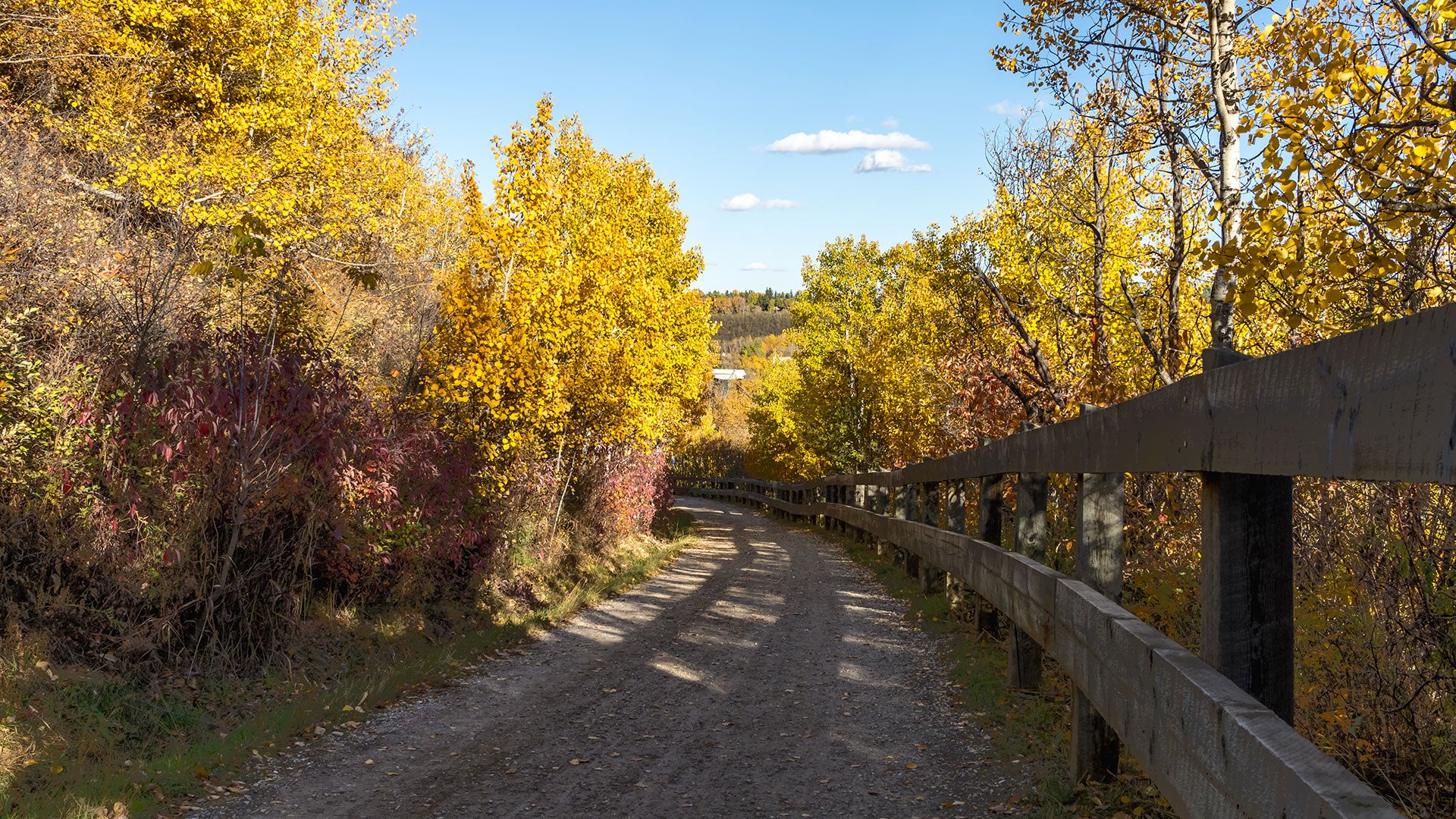
Explore the Green Side of Edmonton covers destinations, resources and other ways to enjoy the outdoors
Explore the Green Side of Edmonton covers destinations, resources and other ways to enjoy the outdoors
Michelle Harris is an unlikely author.
“I don’t think at any other point in my life I’d consider it,” she says. “But I had a need to get this down on paper and out to people.”
The idea that compelled her grew from her career as an environmental educator in Edmonton, working with clients like the Canadian Wildlife Federation and the North Saskatchewan Watershed Alliance.
While Harris (Biological Sciences Technology – Renewable Resources ’11) felt the industry had an eye on aspects of accessibility to enjoying nature, such as financial barriers or even unpaved paths, she wasn’t convinced it did enough to simply extend an invitation to participate.
“Helping people take the first step was a constant issue that no one was addressing,” she says.
So the self-described “tree hugger” decided to address it herself. What started with a single notebook grew into 340 pages of expert guidance to exploring the incredible bounty and beauty of the natural world in and around Edmonton.
Explore the Green Side of Edmonton was published in fall 2025. While Harris wrote it with complete newcomers to Edmonton’s green spaces in mind, her thorough approach means even seasoned outdoors enthusiasts are likely to find surprises.
More than just parks
The book covers popular destinations like the North Saskatchewan River Valley, the Muttart Conservatory, and the Edmonton Valley Zoo. But it goes far beyond these well-known destinations.
Readers will learn about pocket parks downtown, urban wetlands, and the urban food forest in MacKinnon Ravine. They’ll read about some of Alberta’s most beautiful, least visited stretches of wilderness close to Edmonton, like Miquelon Lake Provincial Park, the Riverlot 56 Natural Area in St. Albert, Bunchberry Meadows and Pipestone Creek.
But the book is much more than a list of parks.
It contains recommendations for outfitting companies, tour guides, conservation societies and clubs. It highlights online courses, post-secondary programs, apps, podcasts, magazines and volunteer opportunities.
Organizing the large amount of information in the book to grip and guide the reader was not an easy job. Harris reworked the order and categories several times.
While her NAIT education helped guide her research, Harris relied on her experience as an educator to structure the book.
“As an educator you spend a lot of time thinking about themes and topics,” she says. “You get used to figuring out what bubble things go into and how people will be enticed by that.”
Perhaps the book’s most surprising section is the chapter on climate change and sustainability. These are gigantic topics that can easily overwhelm or depress the reader. That’s exactly why Harris wanted to address them.
“I’ve worked a lot with youth that deal with eco anxiety,” she says. “If I’m going to talk about climate change it needs to be tangible and there needs to be a feeling of hope. Climate change is happening, but these are things you can do.”
More to explore
Since the book was published, Harris has heard from people across her industry and beyond. The feedback has been overwhelmingly positive – though, since Harris is a reluctant author, it might not be entirely to her liking.
“I’ve heard from the community that the book is great,” she says. But it’s also left readers wanting more – in a good way.
Harris has heard from educational institutions that want to use the book as an employment resource for grads and had requests to write similar books for Calgary and beyond.
In the meantime, it’s difficult to imagine a more comprehensive guide to Edmonton’s green spaces.
But Harris can do it.
“The reason this book got published when it did is that I ran out of time,” she says.
“I self-published, and when you do that you only get the services of the publisher for a certain time.”
After almost four years of research, that publisher contacted Harris to notify her of the upcoming deadline. It left her a few weeks to edit.
In three or four years, she expects to return to the text to make updates she’s already imagining.
“Like a painter, you’re never going to be sure it’s finished,” Harris says. “You need to learn to be happy with what it is.”
Northern Alberta Institute of Technology
Mailing Address:
11762 - 106 Street
Edmonton, AB, Canada, T5G 2R1
At NAIT, we honour and acknowledge that the land on which we learn, work and live is Treaty Six territory. We seek to learn from history and the lessons that have come before us, and to draw on the wisdom of the First Peoples in Canada. Only through learning can we move forward in truth and reconciliation, and to a better future together. Read more
About techlifetoday
Techlifetoday is the source for NAIT alumni and students to discover news about the polytechnic, and insights, advice and inspiration from the NAIT community to help them build successful careers and lead fulfilling lives.
